So I’m back after a vacation, and I’ve been going like gangbusters on the bench modification, right?
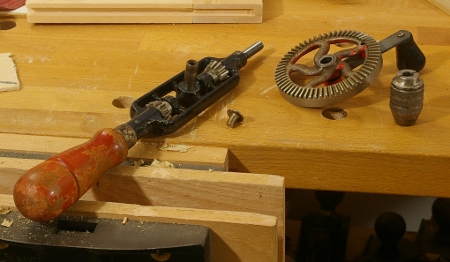
Ha, no. I’ve just been dorking around with this Millers Falls #5A, first taking it apart to degrease:
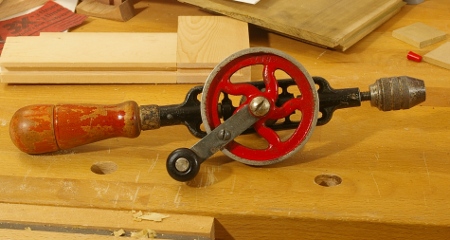
Then I reassembled it and tested it:
By this point, you’re asking, hey wait, don’t you already have two of those things already? Correct; this drill now goes to a friend. After testing it out, I realized that it actually works better than my two #5s (I guess I’d better pay attention to them sometime). It may not be as pretty, as it is a late model with the plastic side handle (type 17, according to George Langford, but hmm, that chuck is different), but at least it’s got a side handle!
One of the tools that I’ve complained about not having from time to time is a plow plane. Well, I have one now. This story gets weird, though, because I never imagined that I would get one in this form:
Time will tell if I’m completely insane for getting a Stanley #45. This thing is as complicated as everyone says it is, and it is quite heavy, but its adjustments seem to work reasonably as a plow plane. Although I have them, I won’t be using anything but the plow cutters (Stanley, how did you even think that the beading cutters have even a remote chance of actually working?).
I set it up with the 1/4″ cutter and moved the nickers out of the way, and it seems to work pretty well. Given that the only grooves I tend to plow are 1/4″, I might just leave it like this. Thanks again to Roger for making an offer I couldn’t refuse. Even if this thing does drive me crazy, I can just pass it along to someone else for the same.
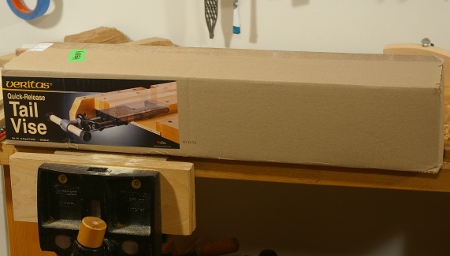
Just as I was getting ready to get started on a new project (or tool), something pops up. In this case, it’s the following:
Thanks to Alex, Jasen, Calvin, Rachel, and Paul for giving this to celebrate a, er, “major life change” (sorry for the vagueness, but I prefer not to go into personal stuff much in this blog).
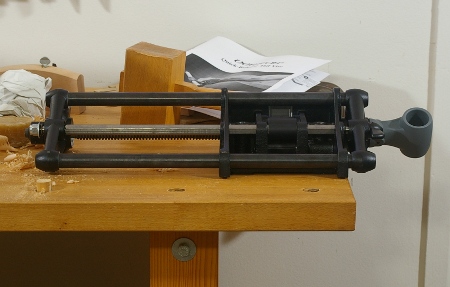
I had a chance to dig it out and look at it today, and you can see that I’ve got to make some decisions on how I want to install this:
The stock instructions from Lee Valley show mounting the vise jaw as an extension to a bench apron. Of course, I don’t have one of those, nor is my benchtop very thick, and furthermore, my benchtop does not have much overhang.
This overhang is the major issue. It seems that you need a little more than 16″ of overhang on the end of your bench to mount this sucker, or otherwise, it’s going to get in the way of your legs. My bench doesn’t have anywhere near that–it’s more like 6.5″ on each side, so I can’t even just shove the top over.
So if I want to use this vise sometime in the near future, I have to make some sort of serious or semi-serious modification. There are these options:
Make a new top. I have enough beech to do this, and I could also look for some reclaimed stuff.
Extend the top by replacing the front.
Make an entirely new bench. [Ed: This is what I eventually did.]
Attempt to make it into a wagon vise.
Attempt to make an L-shaped jaw. Unlike the traditional tail vise jaw, this would be rotated 90 degrees. This is kind of a crazy idea but it might just work and it might be the easiest of the options, because the vise only travels 7″ or so.
In any case, there’s some thinking to do, especially because I had wanted to think about what to do about the front overhang. The Gospel of Schwarz says that the front should line up flush with the legs and I agree. I’ve been itching to make this change to my bench but it does require some work. Perhaps making a new bench would be easier, but do I need another bench? It’s tempting to use the current bench as an auxiliary, especially because I like to clamp stuff to its top, and the edge is great for the bench hook.
Oh well. Lots of thinking to do.
[Ed.: Phil Lang provided this link for what Konrad Sauer did.]
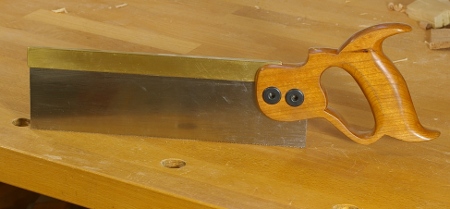
In my last post, I was cutting the teeth on a new saw. This one’s got a plate that’s 10″x3″, .020″ thick, and has a milled brass back that has a 1/4″x3/4″ profile. These parts came from Mike Wenzloff, to whom I owe a lot of thanks for not only accommodating what turned out to be kind of a crazy order, but also for providing tips on how to attach the back and other matters.
I’m not sure what to call this saw because it’s somewhere between a dovetail saw and a carcase/small tenon saw. As I mentioned before, it’s got 16 teeth per inch, which is in the range of most dovetail saws, as is the sawplate thickness, but its plate depth is a bit more than more of those.
My goal was to replace the trusty Crown gents saw that I’ve been making most of my joints with. I’ve been happy with the way that saw cuts, and indeed, I’ve made most of my furniture with it, but I wanted more weight and a “nicer” handle. So since I want to cut most of my joinery with this saw, I’m calling it a joinery saw, I guess.
So with the teeth cut, the back shaped and attached, and the blade waxed up, I grabbed the cherry handle from this saw from before, put holes in the right spots, and it was done:
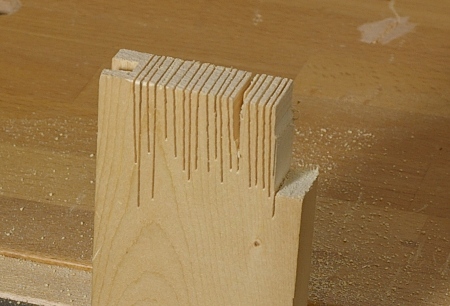
Then I tested it out by slicing the end of a piece of something-or-other to ribbons:
I have to admit, that was a lot of fun.
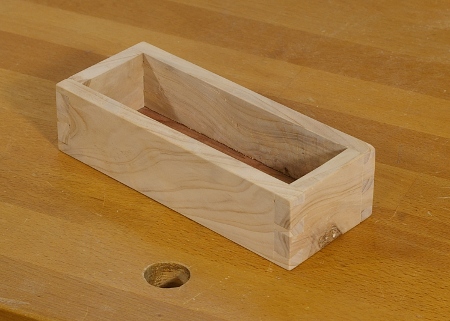
But projects awaited this saw, so I had to get going on them. The first one I worked on was this box:
It’s a small box meant to hold cards the size of index cards. The walls are made from a block of Arizona Cypress (thanks to Roger Van Maren for bringing this in to Bagathon!), about 3/8″ thick. The bottom is redwood, about 3/32″ thick, sawed out with the frame saw.
I’m not sure what in the world I was thinking, because this wood kind of “crumbles out” rather than tears out. The grain reverses like crazy. I had to make a scratch stock-like tool to scrape out the groove for the bottom. But I guess once you get the hang of it, the end result is nice. And the new saw worked really well for those teeny dovetails.
When I remark that I’ve cut teeth entirely from scratch on many of my saws, some people think that it either involves stamping, a machine, or some sort of magic trick. It’s nothing of the sort. If a klutz like me can do it on the abomination of a saw vise that I have, anyone can.
It’s actually quite simple because it’s derived from normal saw-sharpening practice. You start with a file with a handle and flat block of wood as described in Lee’s book and any saw sharpening site out there. To get the tooth spacing, make yourself a little guide. I wrote my own PostScript program to do it (check the Plans and Guides page for PDF versions ugh, gotta restore that some time), but I imagine that there are plenty of ways you can do it with several packages.
Get some reading glasses; they help a lot.
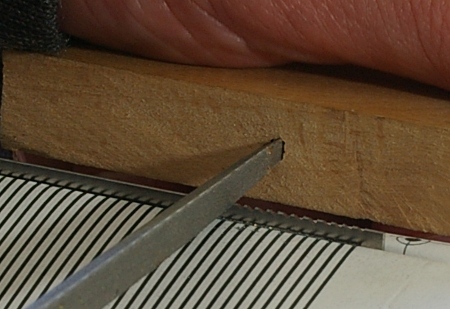
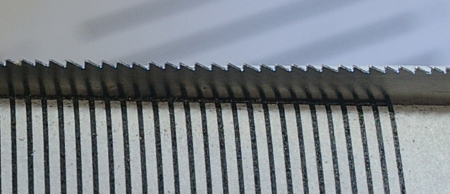
Fold the guide over the front jaw of the vise, put the blade in, just peeking over the top, and make a first pass with the file, just filing in a little notch over the top of each line (sorry about the fuzziness, but I just don’t have a macro lens):
Notice that I’m not really getting the spacing spot-on; you can tell from the flats at the tips of the newly-formed teeth. Don’t worry about this on your first pass–you’re going to refine it later on. You don’t even have to worry much about the file itself on the first pass. The one I’m using here is way too big for the final tooth size (this will be a 16TPI saw that I will reveal later). I’m doing this because I don’t want to put unnecessary wear on a relatively expensive small saw file.
After you’re done with the first pass, do a second pass to go deeper. Make an attempt to correct for uneven spacing by putting a little pressure left or right as you’re filing, but use a very light touch; don’t make any extra strokes with the file just to even it out, and don’t press harder than you normally would. You still want to be fairly consistent in the newly-cut tooth valley size. The unevenness will disappear as you make more passes with the file.
In the saw above, the teeth are so small that I went most of the way with my second pass, this time using a file that’s appropriate for the pitch. You can see that the teeth are slightly uneven, but not by extreme amounts:
I then set the teeth, jointed them, and did a final filing. At that point, the teeth were quite even. It’s important to joint and file after you set the teeth because the act of setting the teeth dramatically alters the orientation and shape of the cutting edges. In addition, you’ll often accidentally set the teeth more than you need. A final pass at sharpening helps reduce the set. For the saw above, I used a fine-tooth saw set at its minimal setting, and it was still too much!
Just when you thought it was safe to go out again, here I go again with the frame saw. This time, I wanted to fix some of the problems I’ve had with the blade-holding hardware. The basic problem is that the bolts I was using were too small for anything reasonable as a cross pin to secure the blade. I bought some 3/8″ bolts and threaded rod to go into the frame, then some stainless steel #4-40 machine screws and nuts to serve as cross pins. I used the same procedure to adapt the hardware as before, so I won’t repeat that.
I thought that I had to enlarge the holes in the frame for the new hardware, but it turns out that I needed to do it to just one of the sides–the other was already big enough (I don’t remember doing it this way). But enlarging the holes means that there’s even more of a weak point in the wood at the very point where it is getting the most stress. Beech is very strong for this application, but I didn’t really want to take any chances, so I resawed and shaped some scraps to bolster that point:
Then I glued them to the frame (with liquid hide glue, of course):
A couple of days passed (while I was working on other stuff), and I figured it was best to let the glue cure a fair amount anyway. When I came back to it, I decided that I’d also do something about the difficulty I’d been having keeping the blade straight while tensioning. It turns out that there’s a simple solution. I grabbed a cutoff from the stack (looks like this came from saw handle project) and sloppily cut a kerf halfway down the center:
To use it, just slide it over the blade when you’re tightening it up:
With these changes in place, I can get the blade much tighter with less work.
Oh, in case you’re wondering why there is a the hole in the blade securer, it’s an experiment in keeping everything together while in storage:
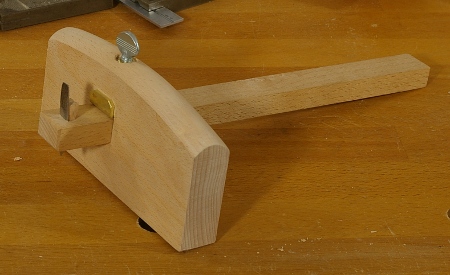
I made a marking gauge a while back, complete with captive wedge and everything. For a long time, I didn’t have a cutter for its arm, so it wasn’t very useful. Then at some point, I made a cutter out of a section of an old saw, and it was then a working tool. The problem was that I never used it, and after a while, I realized that I never used it because I was always reaching for my gauges with thumbscrews. I guess I didn’t like the captive wedge.
To fix this, I decided to ditch the wedge and retrofit a thumbscrew. I bought all of the hardware necessary and immediately proceeded to bore too small of a hole for the screw insert, and this ultimately ruined the fence part of the gauge. I removed the screw insert, gave up for the day, and sulked:
The next day, I milled a new piece of beech to thickness, cut it to size, and mortised a new hole for the fence:
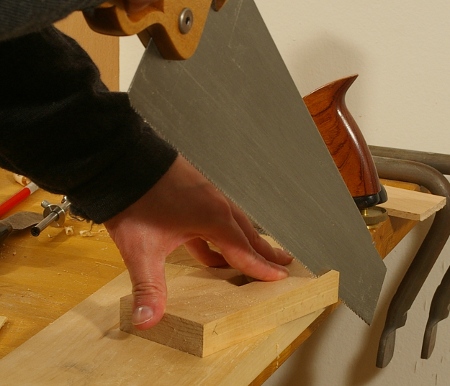
Standard through-mortise procedure applies: Cut halfway through on each side. Easy enough; then I roughed out the fence shape with my new saw (I’m using it more than I thought I would):
I finished the shaping with my saw rasp and some sandpaper–nothing new there.
In all of the thumbscrew-model marking gauges I’ve seen (the metal screws, that is), there’s a piece of metal acting as a guard between the screw and wooden parts. I don’t know what to call this, so I’m calling it a “saddle,” because it’s usually a U-shaped thing that fits over the wood.
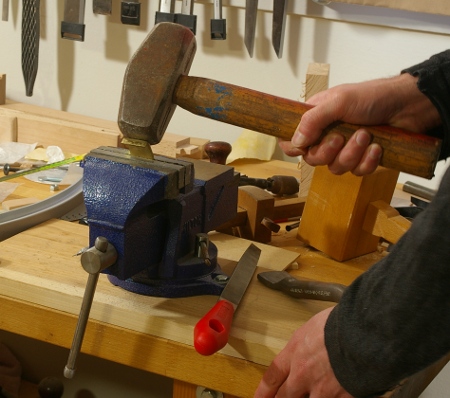
I cut off a piece of brass from some stock I had lying around, put it in a vise, and smacked it with a hammer to try to form it. I guess I was expecting it to be a lot softer, because nothing much happened when I did that. So I took out my little sledgehammer and gave it a pounding. I don’t know if this is the way you’re “supposed” to do stuff like this, but it worked:
After some filing, it fit perfectly.
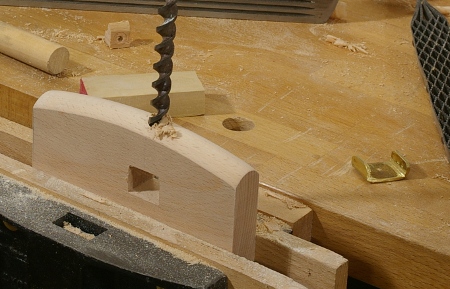
Then I turned my attention to boring the hole for the screw insert. I had already drilled a small pilot hole before shaping, so keeping the bit straight wasn’t a problem, and I’d also learned from my previous hamfistedness that I needed to use a #7 bit, not a #6 bit. Fortunately, I had one:
Notice the finished saddle piece at the right here.
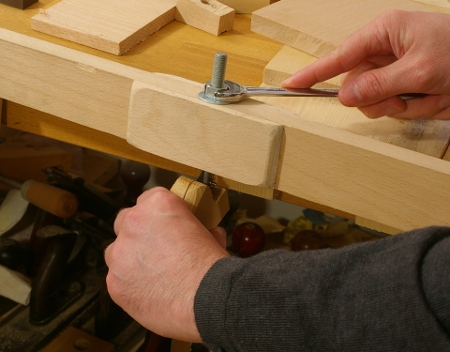
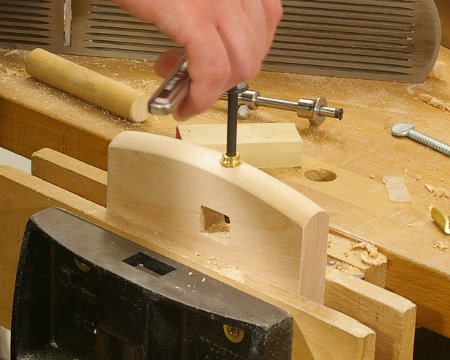
After going to the correct depth with the #7 bit, I finished going all the way through with a #5 bit, then I used a large furniture connector driven by a ratchet to drive in the screw insert:
To finish it, all I had to do was hack the thumbscrew to a proper length and put everything together:
Immediately after putting everything together, I realized that maybe the marking gauge with a thumbscrew and wedged cutter is not as simple of a tool to make as it seems. That’s because there is a limitation of this particular configuration that I hadn’t thought about before, namely, that the cutter can’t be set less than about 3/16″ away from the fence. There are two causes here:
I put the wedge on the inside of the cutter rather than the outside.
The saddle introduces yet more buffer space. That wouldn’t have been a problem if I put the saddle on the side, like some other marking gauges, but I didn’t like the fact that the arm had a little play in that configuration.
How interesting! I know how to overcome both of these issues, but I’m not going to bother for this particular gauge. It’s done and ready to use.
[Edit: See this post for how I fixed the second problem listed above.Also, see this post for a more advanced approach to the problem.]Links not available at the moment, but they are the tweaking and panel gauge links, which might not be restored yet.
[Edit: Bob Rozaieski has put up a video of making a French style marking gauge. Check it out here.]
Progress on my new little saw was puttering along, but with the nightstand finished, I found the time to proceed. The handle was done, the sawplate was pretty much to size but not toothed or sharpened, and then there was the matter of the hardware. I decided to tackle this last matter first.
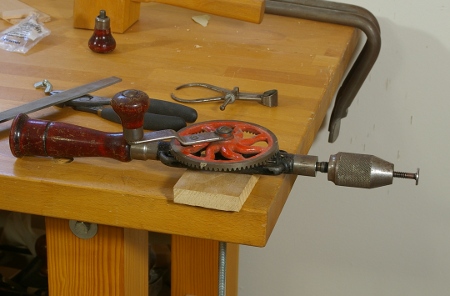
I wanted to do something a little special for this project because the handle is a more traditional style. However, I still wanted to use the furniture connectors that I’d used for my other saws because, well, I like them. Some time ago, and somewhere in the dark corners of my mind, I began to think of a plan to spice up those things. And out of whatever means, I came up with a ridiculous scheme to make sort of a pseudo-lathe out of an eggbeater drill.
The following is what happens when you do unholy things to a Millers Falls #2:
A few notes on this hand-cranked bit of absurdity:
I removed the side handle (seen in the back above) and bolted this through a spacer and a dog hole with a threaded rod and a wingnut.
I used the hacksawed-off tip of the sawplate for this project as a washer underneath. Turns out that the hang hole is useful for something!
The connector bolt is chucked directly into the drill.
I used a pretty coarse file for sizing the head, and a finer one for polishing.
The calipers were really handy for getting a consistent size.
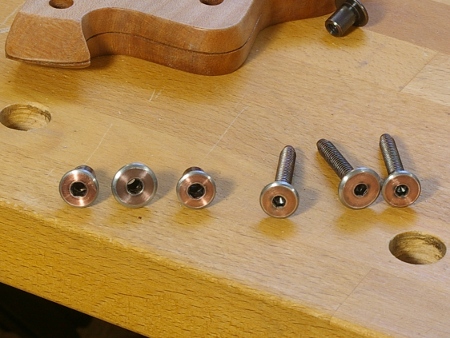
I don’t know why this worked, but it was surprisingly effective. Here’s the transformed hardware (with an original nut next to the handle in the background):
It turns out that the “antique bronze” finish had a bit of copper plating underneath, and when I put some very fine-grit sandpaper to the head while it was turning in the drill, it exposed a decent-looking surface.
Notice that one of the nuts and one of the bolts have bigger heads. Those are my “medallions” to match the original. Although, I suppose that if I were being ultra-correct, I’d size the bolt down to the other ones because the bolts on saws are all the same size. Meh, too much work now–I should have thought about that sooner.
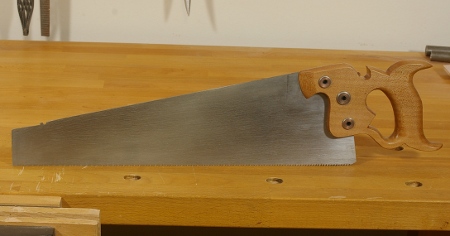
I sprayed a protective coat of lacquer on the hardware and then set out to finish the sawplate. For whatever reason, it took me longer to sharpen this one because it was difficult to get past the remnants of the original teeth. Maybe I wasn’t paying attention. Then I sized up the heel of the plate, drilled the holes for the hardware (with that same eggbeater), and put it together. It was finished:
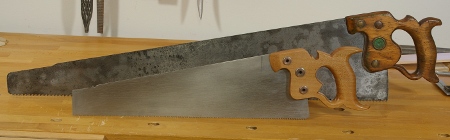
It’s a little difficult to get a sense of scale from the preceding photo. This is a small saw, having just a 16″ blade. Here’s a photo of how it compares in size to my 28″ No. 7:
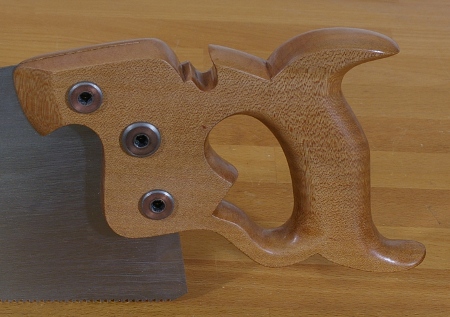
And here’s a close-up of the handle, showing the ray pattern of the nearly-quartersawn pacific madrone that it’s made from, as well as how that goes with the hardware (if it actually goes):
I guess this is all fine and good, except there’s one question that I might not have answered so well: What’s this silly little thing used for?
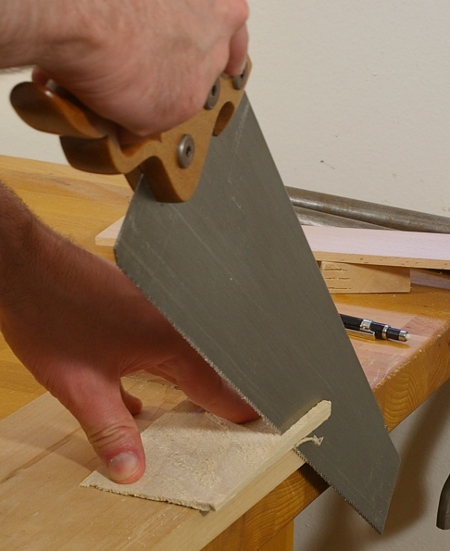
In some earlier posts, I’d mentioned that I’d been having a little trouble ripping panels and drawer bottoms (I use my Pax saw for crosscutting them). Although this is not a frequent operation for me, every time I did it, it was annoying. And I’m happy to say that it works wonderfully for this type of thing, as shown in the test cut below:
All of this said, I would not have made this if not for two things. First, I’d wanted to make that saw handle for as long as I’ve had the original saw. And second, I had that “Kobalt” saw sitting around the shop doing nothing but taking up space. If neither of these had been true, I may have just bought a ryoba for the task.
I will mention, however, that if this saw were filed crosscut, it would make a nice kid’s saw.
My deadline for the nightstand project is Wednesday. [Ed: This was posted the Friday before that Wednesday.] I had originally planned on having this thing done about a week before then, but stuff happened. I’ve been applying varnish to the frame, top, and drawer over the past few weeks and they were finally ready. I rubbed out the varnish with 320-grit sandpaper followed by #000 and #0000 steel wool, all lubricated with mineral oil. I decided not to use rottenstone on this project for two reasons: first, the #0000 steel wool got it to where I wanted it to be, and second, I was afraid of getting it into some of the parts that don’t have finish in them. The second concern was a little silly.
I started assembling the whole thing by drilling holes and cutting recesses in the top stretchers for the screws to attach the top. This was an ugly job that took forever, and I was very silly not to have done this before glueup. I didn’t realize that I would be attaching the top this way until it was glued–I couldn’t find the hardware I was looking for and I didn’t feel like making it. Oh well, it’s not like anyone is going to see this part anyway (it’s on the inside):
Then it was time to solve an uglier problem. The drawer is slightly out of square because (I think) the bottom panel is a hair trapezoidal (thankfully, the end that’s too big is not subject to wood movement). I’ll be a little more careful of that sort of thing in the future, but for now, I decided to make the drawer fit by trimming the side of one of the runners:
Hey, finally a use for my Stanley #75!
With the kludges out of the way, I put in some simple stops for the drawer:
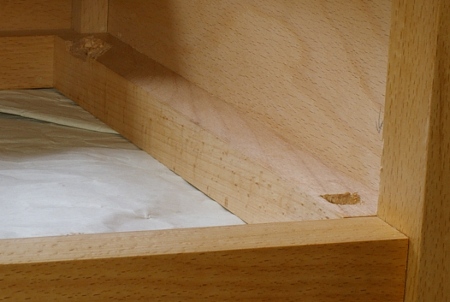
You can also see in the preceding image how the rear holes for the screws to attach the top are elongated to cope with wood movement (and this being riftsawn beech, that’s pretty much a given).
Then, after trimming the bottoms of the legs a little to get them level, I put everything together, waxed the drawer bottom and runners, and it was done:
Here’s a detail of the open drawer:
Though I made more mistakes than I care to admit, reflecting back on this project, it’s pretty positive. Despite the slight goof, the drawer looks perfect and the dovetails are very crisp–and I’d only done one practice half-blind joint a few months back.
Probably most importantly, this was by far the most complicated project I’ve done so far, and I finished it faster than any of my other projects. And it’s done just in time.
I started work on the sawplate by cutting off a bit of the tip so that the hang hole was off and there was a reasonable depth to the blade at the tip. So far, so good–no trouble encountered there.
Then I removed the lacquer from the blade with this clamping arrangement and Norton 3X sandpaper:
That, too, worked pretty well, and to my surprise, it removed .001″ of the thickness of the blade. That got me thinking that, hey, maybe I could remove some of the steel with this sandpaper, too. Maybe I’d even be able to taper it!
Well, that turned out to be an idiotic idea. Spring steel is still pretty hard, m’kay? After wasting who knows-how-long to remove maybe .0005″, I decided that maybe I’d try drawfiling it:
That sort of worked. After expending a ridiculous amount of effort, I’d knocked the plate down to about .032″ (from .035″ originally), and I got the tip of the top tapered down to about .029″ (maybe). I decided to call it finished.
Please don’t try this yourself. It was an incredibly stupid idea, and I’m never going to do it again. If you want a nice blade, I suggest this approach:
Start with the blade thickness that you want in the first place.
Use something like a belt sander with Norton 3X belts if you want to taper grind it. (And remember to use proper safety equipment–a respirator mask, safety glasses, gloves, and something that will hold that blade in place with no chance of letting go.) Not that I’ve tried this, but it’s hard to imagine any way that this would be worse than what I did.
Speaking of taper grinding, I discovered something about it when working on this project. There is a fair amount of smoke-and-mirror action going on with some of these old taper-ground blades. Most full-size handsaws seem to go from a full thickness of about .040″ to around 0.030″ along most of the significantly-tapered tapered part of the top, then it drops down to about 0.025″ at the very tip at the top (maybe the last half-inch). So that’s about 25% thinner along most of the top and I can see where that could be helpful in use. But the teeny bit at the very end? Meh. You hardly ever even have that part in the kerf, anyway.
My Pax saw has similar taper grinding as on the old saws except at the very tip. It appears much thicker than the old saws, but measuring reveals that it’s about the same. What’s going on here?
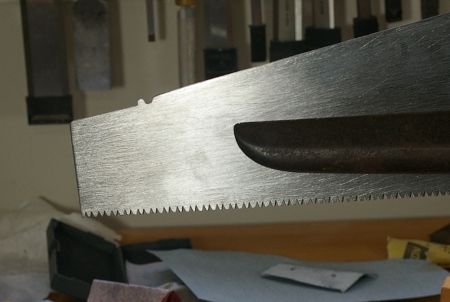
The original saw that I’m copying has less significant taper-grinding along most of the top–its cutting side is about .031″ and it’s ground to about .028″ along the top. That’s about a roughly 10% difference. However, it looks a lot thinner up there, and after a long time, it dawned on me that they’ve rounded off the top of the saw a little to make it look more elegant. It was the same thing with the older saws, and that’s why the Pax doesn’t look like it’s been taper-ground as well, even though it has.
At this point, I was really starting to lose my mind, so I did the same rounding operation on the top of my new sawplate, and guess what? It now looks like it’s been “seriously” taper-ground. Continuing the absurd voodoo practice, I filed a nib onto the thing:
Now I’m almost ready to form and sharpen the teeth. I was originally going to file off all of the teeth and start new ones. However, it seems that the original teeth on this saw were set at 8TPI, which happens to be about what I want on this thing (it also matches the original), so maybe I don’t have to go the whole way.
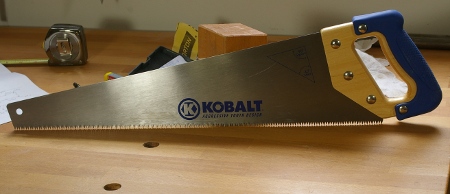
While the handle is in the varnishing stage, I’ve been worrying about how to approach the sawplate for the new saw. Being the cheapskate that I am, I have been considering using the plate from this thing that I picked up for a song and a dance some time ago:
The basic shape is right, but of course, I’d cut the tip off to make it look halfway normal, mill off the teeth, and cut new ones, and do whatever else is necessary to get it fit on the handle.
The trick to all of this is the thickness of the plate. It’s kind of a tricky business, because all of the old saws were taper-ground, and you won’t find a cheap saw these days that is. So I’d be giving that up, but I don’t have any old saws that I can cannibalize anyway.
Furthermore, until now, I really didn’t know the thicknesses of any of the plates that I was working with; I was only able to sort of guess by looking at them. Well, that all changed when I finally got off my butt and bought a micrometer. Why I didn’t get one before, I’ll never know. It’s really taken a lot of the guesswork out of a lot of stuff.
I’d been wondering about this because I’ve got saws that turned out in certain unexpected ways due to this, and I really didn’t know about it before. For example, my crosscut carcase saw works wonderfully, but a rip version of it didn’t turn out the way I wanted it to. The plate on those two saws is .0263″, but you’d really want something more like the 0.020″ thickness found on most dovetail saws.
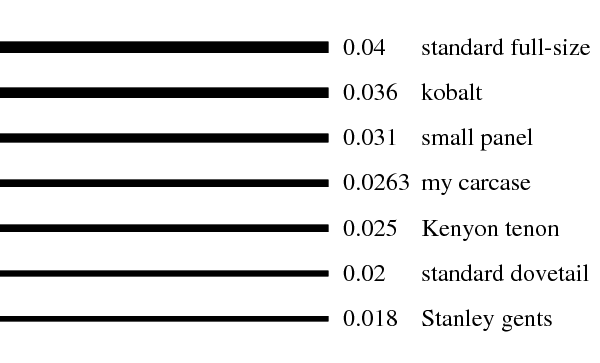
What’s .0063″ of difference? Well, one way to think about it is that it’s 31.5% thicker, which is pretty significant. In theory, you’re cutting 31.5% more wood, and so it’s 31.5% more work to do it. (This does not hold for a crosscut saw, where you are slicing fibers out instead of scooping shavings.) You can also look at it visually; take a look at the following image that I just cobbled together as a PostScript program:
The difference between .020 and .0263 looks pretty striking here. These thicknesses are at the cutting edge. I have the measurements for the tops of the saws that are taper ground, but I’m going to set that aside for the moment.
As you might have noticed, I put labels on this image. Of course, after I got my micrometer, I obsessively measured all of my saws. I don’t have a Kenyon saw, but it’s listed here as a representative for a big tenon saw (the Wenzloff versions have .025″ plates).
There are some surprises, such as that Stanley dovetail saw with the gents handle. This is a relatively new one that I picked out of a basement. I never bothered with it because I already had the Crown equivalent (.0205″), but you can see that it’s quite thin! This is the saw featured in Korn’s book, and it should be pretty obvious that if you’re willing to learn how to sharpen it, it will give you experience with a thinner plate and should work just fine. It’s no wonder he has no trouble recommending it.
So getting back to the question at hand, is the lovely “Kobalt” plate going to work? I think I’m going to give it a shot. It’s about 16% thicker on its cutting edge than the original that I’m working with, but that doesn’t seem that bad (and some of this thickness may be lacquer). The thickness of the original is a little unusual anyway; full-size saws are about 33% thicker. The only blade I have that’s close is my frame saw blade (0.029″), and, er, that’s not gonna work.
Then there’s the matter of taper-grinding. Should I try this? I’ve got sort of an idea of how I can do it without a power tool (although if I were sane, I’d ask to use someone’s belt sander). Would that warp the plate? Hmm.





 Galoototron