Nightstands v2: Wood Acquisition

Normally I wouldn’t write about the mundane process of purchasing and transporting some wood for a project, but after some thought, I noticed that I really haven’t talked much about how I’ve gone about that process. Then, I realized that I actually hadn’t done any halfway serious wood shopping in a few years. I’d gotten the beech for the stool and first nightstand projects through a group purchase off of craigslist, and a fellow BAG dropped it off at my house (thanks again, Kirk!), and the rest of it was either really cheap home center softwood or some stuff I’d gotten long ago in this initial purchase (wow, is that ever a blast from the past–I was still living in my Inner Sunset apartment then!).

I’d also gotten another piece of beech somewhere between those two, which marked the first time that I’d used my roof rack for that purpose. We’ll get back to that rack in a second–it goes along with this post. I’ve seen a few posts from other folks regarding wood transport (including some crazy(?) stuff like bicycles), but not many, which probably indicates that a lot of people have trucks. And for those of you wondering, yes, I may do all of my work by hand, but when I need to move some wood around, you can believe that I’m not going to do it by wheelbarrow or drag it on the sidewalk. [Edit: Turns out that was wrong about that last method, but that’s another story.]

Let’s go back and start with the wood selection. My design was for cherry and called for 1.25″ thick legs and 1″ frame pieces, meaning that I’d some 6/4 or bigger stock . Then each nightstand will have drawers, panels, a top, and a shelf, which calls for the usual 4/4 stuff. I had the amount of board-feet and linear feet necessary for 6″ wide stock computed before I went.

But when you go to the lumberyard, you really don’t know what they’ll have. That especially holds true for cherry, where the stock on hand has all sorts of variations in in color, grain straightness, and especially defects. So you have to have a basic plan at what stock you’ll need for your cutting list, but you need to be able come up with a plan B.

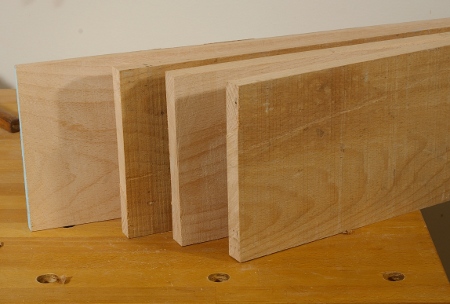
And plan B it was. I really didn’t like any of the 6/4 cherry boards that I saw today. However, the 8/4 stock was only 16 cents more expensive per board-foot, and far better-looking. So even though it will mean a bit of exhausting resawing, I bagged a decent-sized one of those for the legs and the frames, and a 4/4 piece for panels and drawer fronts. I may get another piece for the top later, if necessary.

I also got a piece of 4/4 birch for my secondary wood. I don’t know if that was a great idea or not, but I like birch, and it doesn’t cost much.

Now we get to transporting the wood, and it’s where we get back to the story about the rack. Here’s the load of three boards back at my place:

The rack is a Yakima system that I’d gotten off ebay when I had my CRX. Now, if you know anything about these rack systems, you can switch them from one kind of car to another, as long as you’re willing to pay the king’s ransom that Yakima wants for the little clips that will fit your car (essentially, very expensive powdercoated pieces of pressed steel). As a special surprise, I also had to get new crossbars, because the new Civic’s roof is much wider than the old one. Thankfully, I was able to dodge Yakima’s cash vacuum on that one by just getting some 3/4″ galvanized pipe from the hardware store.

Now here’s how the choice of car gets a little tricky. I like my 2-door, mostly to annoy any passengers that may end up in the back seat, but this is one instance where having the 4-door is better. You see, on the 2-door, you place the bars only 18″ apart (unless you pay another arm and a leg for Yakima’s extender kit), but on the 4-door, you put them 32″ apart. A longer spread helps keep the load from rotation forces and keeps boards from springing around so much. To avoid that altogether, you can tie the load down in the front and the back. Because this was a short trip (and wood has a much smaller aerodynamic profile than, say, a canoe), I didn’t need to do that.

So, yeah, had I thought about this when deciding between the coupe and sedan, it would have been a consideration. However, the 4-door had a big problem that I don’t think I could have overcome: You can’t get it in the color you see above. [Edit: Also, new for the 2012 Civic 4-door, you can’t get the EX trim with a manual transmission. This is far worse than the wrong color. But you can still get it with the EX coupe.]

[Note: The Schwarz also has a what is essentially a Civic, and but he’s basically gone the infill route by getting the old Acura version. I have to admit that I miss the hatch of the CRX.]

Okay, back to the load. Let’s see how I fasten the boards to the roof. Here is the driver’s side, which has the 8/4 cherry:
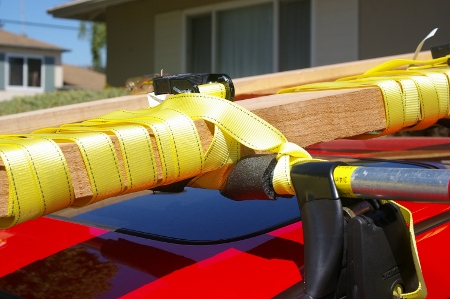
I put pieces of foam pipe insulator around the bars, then put the wood on top, and fastened things together tightly with a ratchet tie-down–which is essentially a band clamp. The ratcheting ones let you get the grip good and tight, compressing and locking the board into the foam. This not only takes a lot of slop out of the fastening, but also adds some friction to the surfaces; everything is always in contact with something else, even if you hit a bump in the road (and California roads have plenty of those). The boards were shorter than the length of the car, so I did not need to put a red flag on the end to indicate an overhang (as you would need to do if you let your boards hang out the back of a pickup or van).

These tie-down clamps have really long cords, so you have to do something with the excess. On the driver side, I’ve wrapped them around the board several times, then tied the loose end to the bar. It doesn’t need to be a strong knot because the ratchet mechanism is doing all of the hard work.

On the passenger side, I put the two thinner boards together, but this time, I got lazy and put the loose end of the straps into the car. I wouldn’t do this on a long trip because it makes too much noise:
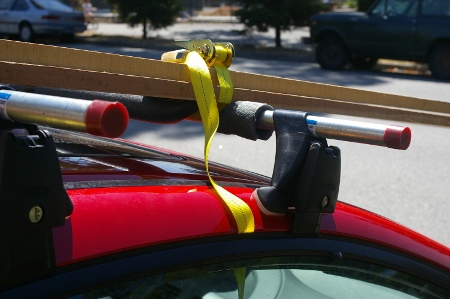
Once I was finished fastening everything, I gave them a bunch of pretty hard shoves to make sure that they wouldn’t budge.

As far as the capacity of the rack goes, I’m pretty comfortable with these two boards on top of each other, but I don’t know about three. In any case, there isn’t room for much more. The weight limit on the rack and the roof itself is 125 pounds, which translates to around 35 board-feet of this density of wood. There were 23 board-feet on there today. This is just fine for a small-time woodworker like me; it’s just very unlikely that I’d ever need to buy much more wood than this at once, given what I currently do.

But what if I did need to haul more? Would I get a truck? A significantly cheaper option would be to get a trailer. My car’s towing capacity is 1000 pounds.
Qilan Mountain’s Divine Trees

Sometime during the last year, I read about Qilan (Cilan) Mountain in Taiwan and have been wanting to go there ever since. I’d read that there were large, old-growth trees of both Taiwan red cypress (Chamaecyparis formosensis) and Taiwan yellow cypress (C. taiwanensis) there, and had wanted to go there ever since. Somehow word of this got to my mother-in-law, who promptly booked a family trip for us; the family had been there before. The post on Luodong describes what we did on the first day of this trip. Many thanks to her for arranging all of this.

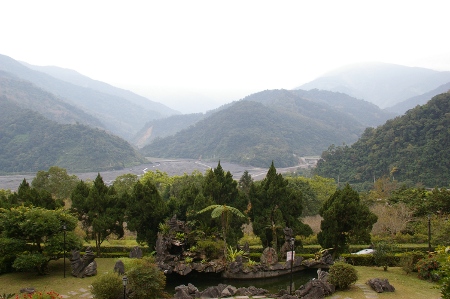
The area is called “Divine Trees.” It’s not wholly virgin old-growth forest; it has been logged, but many trees here were saved. Though it’s not far from Yilan or Luodong (maybe about 25 miles as the crow flies), getting there gives you plenty to think about. You start out in the valley (400m/1312ft). Here is the view from the forest recreation area there, next to the hotel where we stayed:

Then you head up highway 7. If you’re familiar with mountain roads, you probably have an idea of what this is like; if not, refer to C. W. McCall’s lyrics on Black Bear Road–”it looked like a bunch of Zs and Ws all strung together.” Unlike the Black Bear Road, highway 7 is actually paved, and you go up from the valley for about a half-hour or so. Then, around 1000m (3280 feet) or so, you turn off, go through a staffed controlled-access gate, and ride for another half-hour or so on an unpaved road that isn’t really any different in shape than the paved one. If you want to go there, it’s best to go on a tour. For one thing, a guide can tell you a lot about the place, and furthermore, I don’t know if they’ll even let you in without a guide.

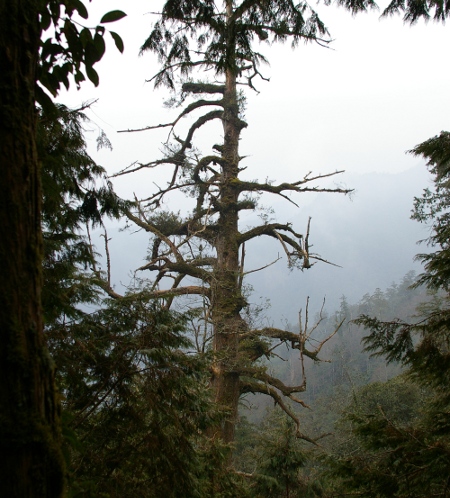
During the trip, if you’re not battling motion sickness, you see the forest changing around you. In the valley, the forest is far more of a jungle, with broadleaved trees, fern-like plants, and vines all around (monkeys in the warmer months, too). But as you ascend, you start to see Taiwania (Taiwania cryptomerioides, an important timber species, but not the subject here). If it’s not a clear day, you reach the cloud cover and it becomes foggy. You start to see trees with the scaled foliage sprays that you see in so many genera/species in the Cupressaceae family. It’s a sign that you’re getting closer. Then you see hulks of grey, dead trees towering out of the forest on the mountainside:

At some point, you’re at your destination at around 1550m (5085ft). It’s time to get out and see some real trees. There’s a trail here with two variations; the longer one is about 2km long, with more than 50 trees, the other has a little less than half.

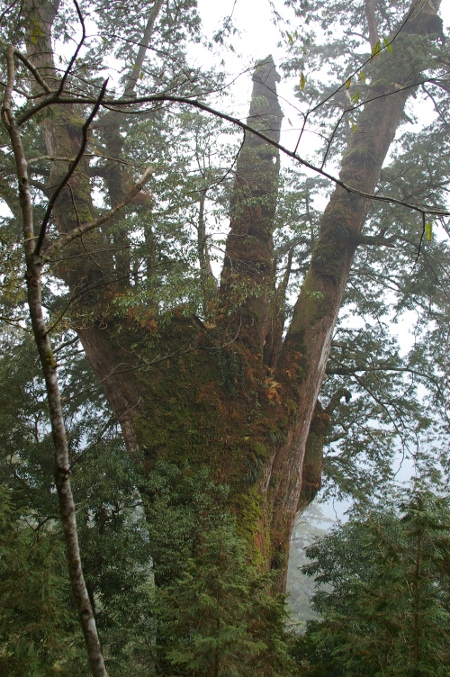
The first trees on the trail are among the largest and oldest in the area. Everything at the beginning of the trail is a red cypress. It’s hard to get an idea for the scale of these trees, especially when you look across to them from higher up on the hill:

A few notes about the Taiwan red cypress are in order:

  • It’s got a branching form, usually high up on the trunk somewhere. The branch forms seem to vary quite a bit; the example above has the vase-like form that you might see on an elm tree. Others don’t split quite like this.
  • It grows really slowly. Think “coast redwood or old-growth douglas-fir” really slowly.
  • In time, its bark and shape do not expel the elements as many other trees do. You can see all sorts of moss and fungus on this one, but did you notice the pepper tree growing high up in the crotch?
  • After about 500 years, the tree starts to become hollow; bugs eat from the pith out. They don’t eat anything younger than this. I didn’t catch what the relationship was to the sapwood, but in any case, the ideal tree for harvesting is about 500 years old because of this. Anything older was often spared because it was not high-quality wood. There are a few examples of 500-year-old trees in the area, and they definitely have a different look.

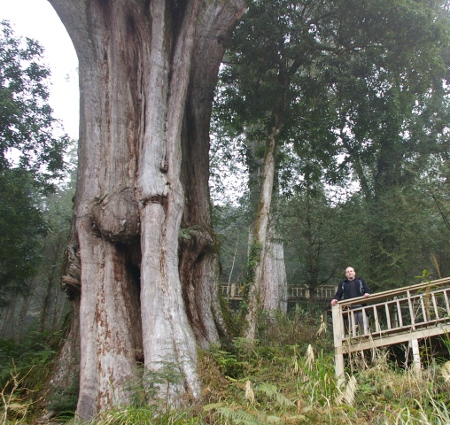
But I did mention that these things are big. When we got around to the trunks of the larger trees, you start to understand what the “Giant Cypress” part of Wilbur Pan’s blog name is all about. The preceding photo was a first impression of a particular tree. Then we got around to the other side of it and got a better idea at what was here:

It’s not only big, but it’s quite pretty, too. As with all of the big trees, it has a marker with its name and some information:

Most of the stuff on here should be pretty self-explanatory (DBH being diameter; breast height). It’s a little difficult to compare this to trees such as the giant sequoia and coast redwood, which are a little thicker and a lot taller, but the dimensions do generally match the historical record of a tree that we may be lucky enough to resurrect in time: the American chestnut. Botanically, of course, the chestnut is far different (being a fast-growing angiosperm and all), but now I finally have an idea for what the presence of those things was like.

(All of the large trees have names such as this; Szuma Chien was a famous historical figure in China that lived around the same time this tree sprouted.)

And so on we went through lots of red cypress (some even comical); here’s one that’s “only” about 1000 years old. You can see how its form at this age is far different than the older ones, and in particular, how much larger its crown is:

According to the sign for this tree (No. 31), it is 34 meters tall, 1.5 meters wide, and is named Shin-ma Kuang.

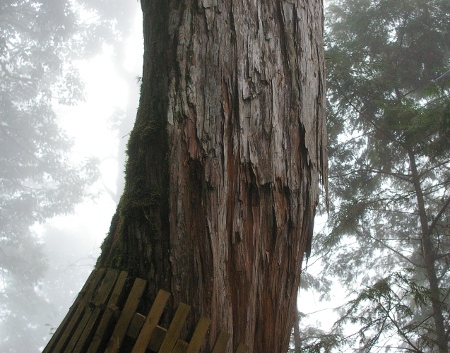
We saw a few other types of trees, but then, somewhere near the end of the walk, we stopped at a big tree and I knew immediately that there was something different here. First, the bark was different; it was shaggy, not unlike a shagbark hickory. It also didn’t hurt that the trunk had a fence around it:

The guide explained that this was a Taiwan yellow cypress (“hinoki”, sometimes classified as the C. obtusa hinoki cypress, but otherwise known as C. taiwanensis). It is principally famous for its aroma, the fact that bugs hate it (unlike the red cypress, they do not hollow with age), and that they have a remarkable resistance to rot. The wood has a tremendous number of uses. It’s also extremely rare because the lumber is so valuable that most of it was logged. There are only five old-growth examples in the entire area! Think of our own C. lawsoniana (Lawson’s cypress, or “Port Orford-cedar”).

And of course, the fence is necessary to keep people from picking at the bark when they learn what this tree is.

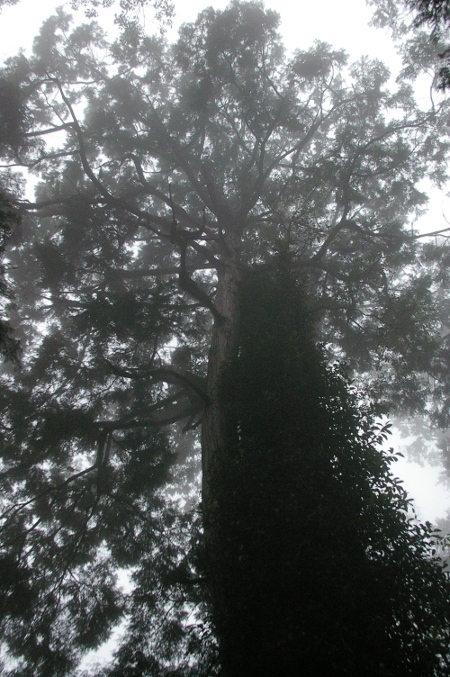
Looking up at a yellow cypress, you can see that its form is more excurrent than the red cypress. It’s hard to relate the sort of effect this imparts in words or a photograph.

(If I were into sayin’ profound stuff, I’d say that the tree is saying “The cypress tree on the mountain” to us. But I’m not, so I’ll just say that the tree is telling us that trees don’t talk.)

This tree, named Chu Hsi, is about 900 years old and 1.8m in diameter. I don’t know why I found this one particularly nice-looking, but I did.

Coming up: Back to woodworking and tools! Of course I went shopping for tools when I was in Taiwan.

Nightstand: Drawer Tuning and Pulls

All of the dovetail joints for the drawer are now cut, the bottom panel grooves are in, and the panel itself is glued up. That leaves some fine-tuning of the drawer.

I found that the sides were a really tight fit, one that was likely to become too tight with the addition of too much humidity (or finish, for that matter). To fix it, I knocked off 1/32″ from each side with my jack and smoothing planes, and now it’s much more comfortable. I also had to trim a little off the tops, which was not a problem, either.

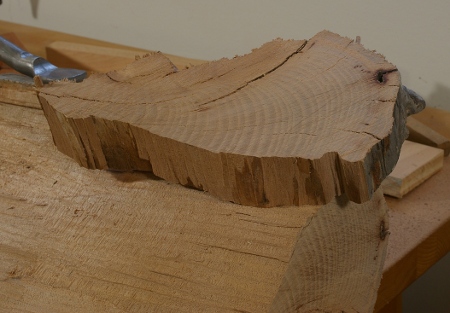
The matter of the pull remained. I could have bought something, but I decided that since this piece already had one thing that I stole from Krenov, I’d just do it again and make some sort of tongue-like thing. So after one false start, I pulled out a cutoff of the pacific madrone that I’d fooled with earlier and started sawing:

After some cuts and a little bit of planing, I got down to a roughly-rectangular chunk:

Then I put this into the vise, got out my favorite shaping tools and started working:

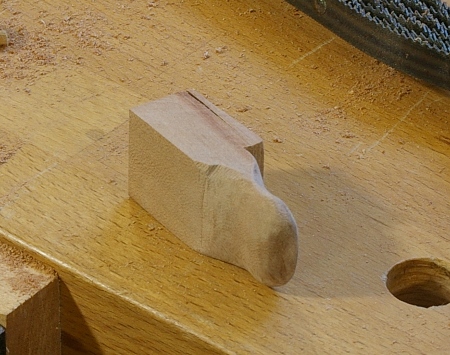
Before long, I had the basic shape that I was looking for:

Check out all of the rays that madrone has. Working with this little piece has been fun. It planes, cuts, and pares very easily, similar to apple or cherry. I’m a little unsure what to make of the way it feels when you touch it. It has sort of a soft, dry feel, but it’s not a terribly soft wood. It’s almost a “chalky” feeling. I’m looking forward to playing with some larger chunks.

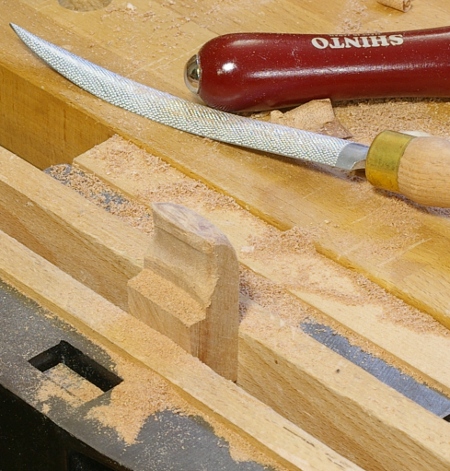
Then I put a mortise in the drawer front and (carefully) cut the tenon in the pull:

A test-fit indicates that it seems to look the way I intended:

I think I might have some final smoothing to do on it, but that can wait until the drawer is glued up, and that step will come in a few days. There isn’t much else left to do on this project other than finish off the top and varnish everything.

Nightstand: Frame Pieces Milled

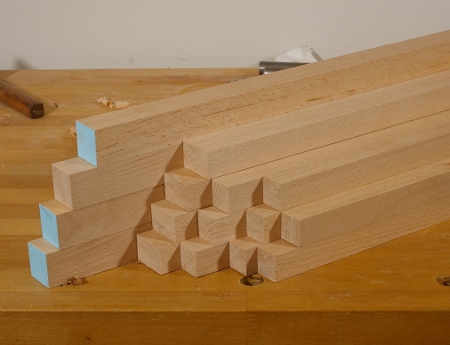
After a lot of resawing, scrubbing, and milling, I finally have all of the frame components milled to size:

It was a moderate amount of work–less than I thought, but still non-trivial. One of the biggest problems that I’m having is that the board I’m using has quite a bit of tension built up inside. Flatsawn 8/4 beech will do that to you. In any case, whenever I resaw (and sometimes when I rip), the board moves and I end up with some cupping. My reference face would be flat before the resaw, then afterwards, it would get cupped again–sometimes almost as much as 1/32″. By the third time this was about to happen to me, I wised up and took a slightly different approach so that I minimized the amount of waste and work that I had to do:

  1. Use the scrub plane to get the reference face flat.
  2. Use the jack plane with the heavily cambered blade to even out the scrub marks. A fore plane set up the same way would work fine, too. After this, the board should be pretty flat. Don’t break out the jointer yet.
  3. Scribe a line around the edges of the board from your reference face. Set the gauge 1/8″ thicker than the thickness that you’re ultimately aiming for. The line probably won’t be super-straight, but it will be straight enough.
  4. Resaw along that line. If you’re using a hand-powered saw instead of a bandsaw, do not forget to grunt and/or growl occasionally. The least you can do is scowl.
  5. Your reference face is no longer flat because some of the board’s tension was released; sigh if necessary.
  6. Reflatten your reference face, using the scrub first if necessary. This time, use your jointer, winding sticks, and all that jazz to get it totally flat.
  7. Scribe a line around the edges from the reference face, this time to the intended thickness, and mill down the opposite face as you normally would.

So in theory, I’m ready to cut some joinery. However, before I go crazy and start chopping mortises in the wrong place again, I have the the drawer, panel, top, and shelf components to mill. I’m using the wood left over from the resawing for the drawers and panels so that they match the frame:

There’s enough wood here for all of the drawer and panel parts. Unfortunately, I have to do a lot of hogging and flattening on these pieces, too. The good news is that I don’t have to resaw any of these.

With these pieces all earmarked, that means I have (practically) nothing left from this board for making the top and the shelf. I’m a little surprised; I thought that one 6′ 7-inch-wide 8/4 board would be enough, judging from its weight and what I was visualizing. What I didn’t count on was how much all of the cupping and re-cupping from resawing would use up so much wood. This is fine, though; I grabbed another board from my stash and cut off a piece today. Perhaps it’s even better this way, because now I know that the top will be have consistent-looking wood, because its components will all come from the same part of one board.

Diversion: Wood Extraction Attempt

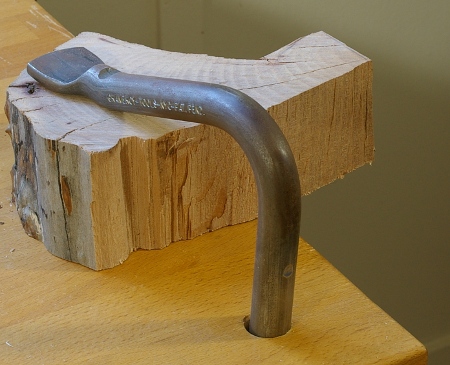
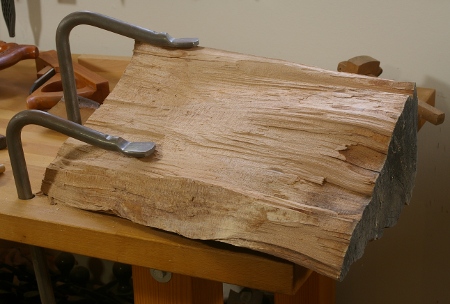
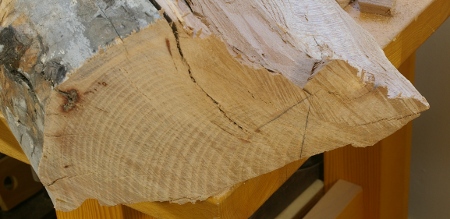
There I was, milling away for the nightstand project, when I felt like I’d really like to take a break. I remembered a recent thread over at Dan’s Shop where I mused that I really ought to do something with that madrone that I had gotten back at Bagathon. My idea has been to make a handle for my “dream dovetail saw” that I’ve had in mind for a while, so I picked up a chunk, looked at it, and then fastened it to the workbench:

Now, this piece hadn’t really been properly cut or dried or anything. It’s just a piece of a log that Larry had sitting out, and by the time we got to it, it was plenty dry. Tom Holloway and I split it up and several people took pieces home. I have two of them. The other one is thinner than this one but it might be a little more straight-grained.

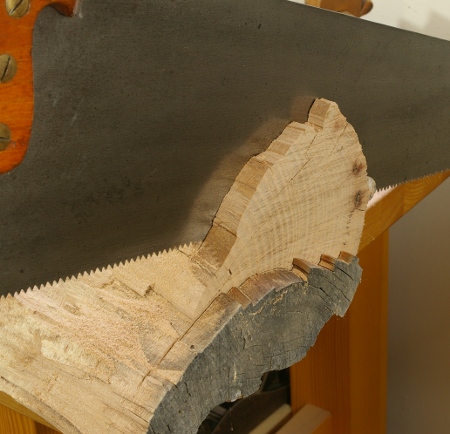
And so there it was, sitting on my bench, and I was wondering if its checks were too many and deep to get a piece unbroken enough for a saw handle. To find out, I started sawing. The first cut I took wasn’t too promising (pieces kept falling away), so I went in deeper:

It looked better, so I went in even deeper and got this far:

As it turns out, sawing this stuff is a pain in the butt. And I’ve been sawing beech for the last several months, and let me assure you that beech is not particularly pleasant in that respect, either.

I was far enough that I thought, hmm, maybe I have a shot at this. Maybe if it fails I can just get two smaller pieces and glue them together. But first, I wanted to split off some sections that I definitely knew were not going to be of much use to the handle but might be useful for something else. I marked them with a pencil:

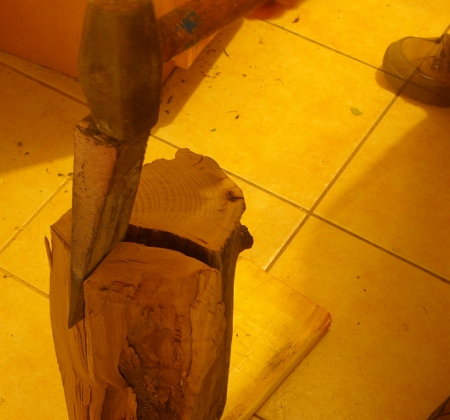
Then I went outside with the wedge and small sledge (I can’t remember now, where did I get a wedge? Or the hammer?) and took a few swings. Then it occurred to me that the sound was propagating (loudly) all over the neighborhood and that it wasn’t really the time of day that I should be doing that kind of thing, so I went back inside to finish the job. I managed to find a spot that has even worse lighting than the shop, resulting in this bizarre 8-second exposure:

Hey, it worked though. I should warn you, though, that my foot is not transparent in real life.

Then I sawed away some more and now still wonder if I have enough wood in there for what I want. I know that it’s close. And I also wonder why it is that I’m doing this, exactly. After all, I have pieces of apple, cherry, as well as a near-infinite supply of beech, and I supposedly don’t care too much about the way my tools look, anyway. I think I probably just want to reduce my wood supply.

New Dog Holes, More Milled Wood

I’ve been doing a lot of milling and resawing lately. My prototype bookshelf will use the following pieces of yellow-poplar that I dimensioned:

Yeah, I know, it’s not too exciting, it’s just some wood.

This stuff was quite cupped when I started out, so I had to do a lot of work with the scrub plane to get it flat. To do so, I decided to put a second row of dog holes in the workbench so that it would be easier to plane across the grain:

To use them, just add some dogs in the appropriate holes, as shown here by this evil piece of beech:

It’s been working well so far. I’m considering adding one more at the corner so that it really doesn’t have any room to move around, but it’s not important right now.

Why, you ask, is that board evil? Well, it’s from a piece of 8/4 stock, about 11″ wide. To get to the point of resawing it, I had to flatten one face. No problem, except when you don’t hammer in the scrub plane wedge enough. When that happens, the blade can pop out when you’re doing hard work. The overall consequence, then, is minor carnage. Ouch. I lost a few days of shop time from that.

In any case, this board is for another project that I haven’t talked about yet. I’ll post more details on it later.

Taiwan: More Tools, Sitou

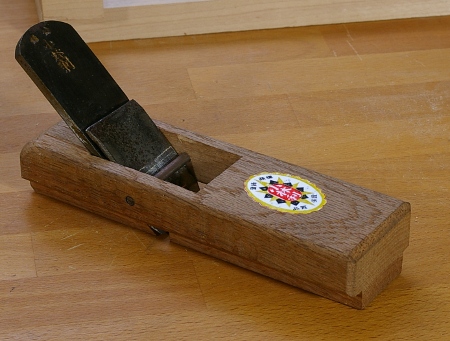
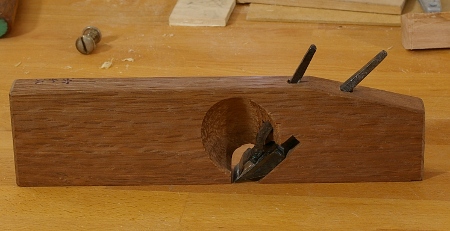
Continuing with the survey of tools that I got in Taiwan, here’s a funky rabbet plane:

The body is pretty clearly some sort of white oak, the only such example that I picked up. The blade is laminated and decently thick. This was one of the more expensive tools that I got; I think the cost was about $15.

The big characters on the blade and on the red part of the sticker comprise the brand name. On the rest of the sticker, it says something like, “very good quality,” and it seems to hold true. Everything mates perfectly, the mouth is tight, and it produces good, smooth shavings. I managed to do some panel-raising with it.

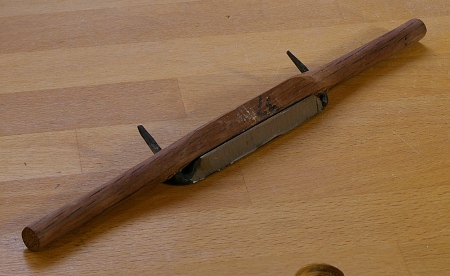
Next up is this wooden spokeshave:

This is a little larger than most western wooden shaves (maybe about 60% larger), and it was not their biggest model, which was enormous. The “37” is the production number (apparently out of a run of 100). The blade is hand-forged and decently easy to hone; you can straddle a 2.5″ stone with it. It works well. Cost was about $8.

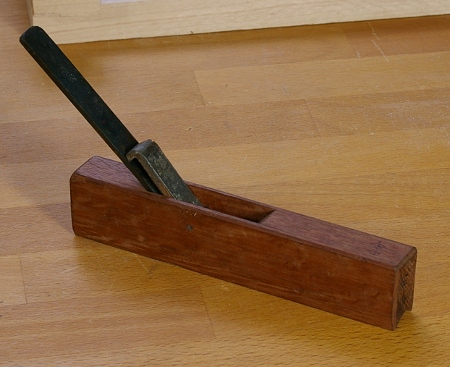
Next up is a rounding plane. We’ve seen a bunch of similar tools under the brand Mujingfang, but this Taiwanese version uses a metal plate rather than the wooden wedge found in most of the others (I didn’t see a single wooden wedge in any Taiwanese-made plane while I was there):

The size is printed on the top near the toe. As with all of the other tools I bought, it works spendidly. I think the cost was about $10.

So switching away from tools, let’s look at some tree stuff. One of the places we went was Sitou, which is home to the Sitou Forest Recreation/Nature Education Area. It’s an experimental forest run by National Taiwan University, and you can see many different kinds of trees that they’re playing around with. They even have a California redwood or two there, which is kind of fitting, since we have a Dawn redwood in Henry Cowell Redwoods Park here.

In any case, there are a bunch of things you can look at, and one of the most interesting is the Skywalk, a walkway on a trestle that extends from the side of a hill that goes right into the forest canopy. It’s not every day that you can just walk around the middle of a bunch of Japanese Red Cedars:

(Yes, there are birds, bugs, spiders, and all sorts of stuff up there.)

The forest is hardly old-growth, though. It was once dominated by the Formosan Cypress (Chamaecyparis formosensis), but like so many good trees, it grows slowly and is far too valuable for people to actually want to conserve in any reasonable fashion until all of the trees are gone. But there’s one cypress of note there, a giant 2800-year-old cypress considered a “sacred tree:”

Of course, the only real reason it was spared is because it is too hollow and crummy to be used for timber, so they called it “sacred” instead. Hmph. In any case, it’s pretty amazing.

Taiwan: Sanyi Wood Sculpture Museum

I’ve been in Taiwan for the last couple of weeks, so I haven’t been in the shop. However, I got to see a lot of stuff on the trip, and now that I’m back, I can start to post about some of the wood-related things I did.

First up was a trip to Sanyi Village to see the Wood Sculpture Musuem (三義木雕博物館):

Sorry about the lack of photos inside the museum. They don’t allow photos.

If you’re into sculpture or carving at all, this museum is pretty much a must-see for the island. It contains stuff from ancient times, to the Formosan aborigines, to the Han and Hakka sculptors, to contemporary pieces from their annual contest. There are also galleries containing temporary exhibitions. Make sure you get the audio tour, especially if you can’t read Chinese characters–there is an English one available. There’s quite a lot of information in the audio tour and it takes quite a while to go through it all.

There’s also a studio inside the museum where you can see and talk to a sculptor at work with traditional carving tools. I’ll try to explain this in a later post, but I think I need to do a little more research on the matter.

The village itself is full of shops containing lots and lots of pieces for sale. A lot of this consists of the garden variety happy/laughing Buddha sculptures and carved fruit (sometimes made from cypress; take off the cap and smell inside for the effect), but there are some interesting pieces as well.

By this point, you’re probably wondering if I went tool hunting during this trip. The answer to that question is, “yes,” the answer to the next question is, “quite a bit,” and here is a sampler:

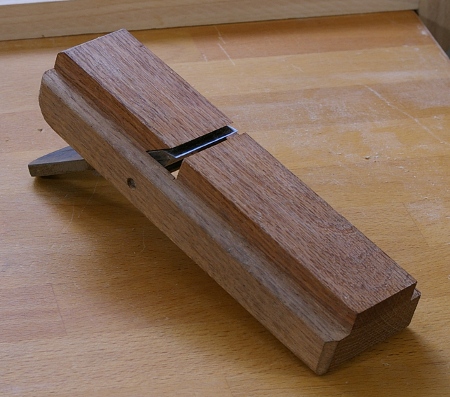
This rabbet/shoulder plane was handmade in Taiwan, somewhere in the south. I’m guessing that the wood shaping was done by machine, but the finish looks handplaned, and the blades are hand-forged. The iron is laminated. I’ll have more on this plane later, when I have a chance to play with it.

And, no, Dan, I don’t know why we both posted about weird rabbet planes on the same day.

Pennsylvania Fall

Lately, I’ve been trying to visit PA every fall, when the weather is nice and the leaves look good. This year, the weather was not so great most of the time, but there were some nice spots and we did get to do some hiking around. This hiking, it’s fun not only because the leaves look really nice, but you also get to see the trees where your wood comes from.

One of the more interesting places was David’s Vista up on the Jackson Trail by Pine Grove Mills (near State College). It was there where this tree shows how a ridgetop tree weathers:

There wasn’t really much burl here, but the cambium layer has definitely been twisted around the crotch area between two branches. Talk about reversing grain! As to what kind of tree it is, there was a red oak growing out the side of this, if I recall, so that might be a good guess (even though everything else in the background was a pine).

Other sights from the trip include the vista itself, some leaves collected on Mt. Nittany, and leaves from one of the chestnuts growing on Mt. Nittany:

And now it’s time to get back to work here at home.

A-Lumberin’ We’ll Go

I finally made it to the lumberyard today. My official excuse was that I was waiting until I fitted the roof rack to my car. I did that last weekend, and then today, I decided that since I don’t have any fancy needs right now, that I’d just have it chopped into 5-foot lengths, which do fit into my car. That’s a hell of a lot easier than strapping boards to the rack.

This was pretty much my first experience at a place that actually has a lot of hardwood. The English spoken there was kind of spotty, but they were nice enough, and after a lot of back-and-forth, I’d selected a few FAS roughsawn yellow-poplar boards, and one nice roughsawn piece of cherry.

Roughsawn wood is not exciting for most people to behold.

That’s the cherry on the left, and one of the pieces of poplar on the right. However dull this looks to most people, though, it’s thrilling to me. And somehow I feel like I’m on some sort of slippery slope now, because my downstairs storage now contains a bunch of boards, just waiting for me to take a whack at them.

So now I’m ready. The only excuses I have for not seriously practicing joinery are either that I’m being lazy or I’m doing something stupid, like playing a video game or doing laundry.

In other news, I finally got a low-angle block plane. I had a prepaid visa gift card to blow, so I blew it on the offering from Lee Valley/Veritas. It was not a trivial expense.

Some people complain that it “doesn’t look traditional.” Traditional compared to what? The cast iron planes that looked all non-traditional in the 19th century? Yeah… okay… right.

Anyway, that plane is freakin’ awesome. Those guys do not monkey around when making a tool.

Oh, yeah, and I have my 8000x waterstone now. Yippee.