Bookshelf: Munging Mortises

I cut the other dovetail joint for the top of the bookshelf and was feelin’ pretty good about it, and I thought that it might be a good time to start on some of the stretcher pieces that will provide the rest of the racking resistance. There will be three of them, two in the back, and one at the front at the bottom that will be a plinth (“kickboard”) piece.

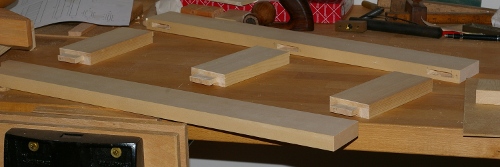
The mortise in the back near the bottom was my first target, and I proceeded immediately to chop in the wrong place. I didn’t realize this until I had been away from it for a while, so when I came back, I extended it upward until it was in the right spot. You can see it here with its matching tenon:
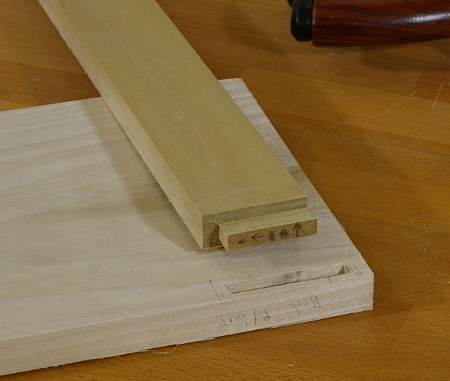
Thankfully, it will not be visible when this project is complete, but I really have to make this lesson count for something.

I chopped the mortise on the other side and cut its tenon without a hitch, so I was again feeling pretty good about myself, so I decided to go after the plinth next. And, of course, I went straight out and chopped that one in the wrong place, too. You see, this piece is supposed to be inset a little into the depth of the shelf, not flush with the front. However, I used my already-set cutting gauge to mark where to chop, and I marked it in a position that would have the plinth flush. Argh.

Well, I couldn’t resort to the same old stupid trick to fix this one, because the mortise was the right length, but at the wrong depth. So I thought about it a little, and decided that since I hadn’t cut the tenon yet, I would modify the tenon location instead. And so here’s the hack I came up with:
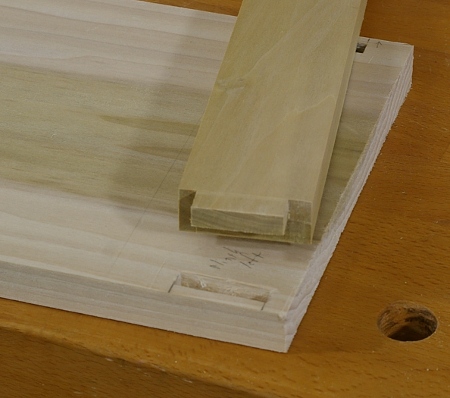
Yeah, so I just moved the tenon over to one side of the piece. It’s stupid, but it does work, as shown in this fitted view:
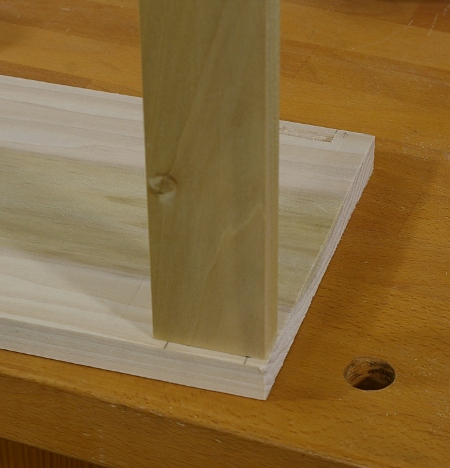
I don’t think I’ll be making that mistake again, because I’ll probably do all of them this way from now on. The reason is that I won’t have to change my marking gauge for it. Though I am sort of happy that I discovered a way to deal with this sort of thing, I am not happy that I wasn’t paying better attention in the first place.

But then again, it is called my prototype shelf for a reason. I already have a few modifications in mind when I build larger examples.

I have three more of the mortise-and-tenon joints to make on this project, then some housed joints, and the final (dreaded) part is making and fitting the rear panel.
Bookshelf: The 60-Year Dovetail

I’m slowly making my way through the prototype bookshelf project. After realizing that my widths were all wrong, I had to spend some quality time with my rip saws and jointer plane to fix all of it, and I was able to do that during what little time I had this weekend.

So then I decided to get started on the dovetail joints for the top, and let’s just say that my dovetails are not the famous five-minute variety. I don’t get a lot of uninterrupted time in the shop these days, so I just cut whatever I can, and stop when I need to. On Monday, I laid out the tails and cut them. Yesterday, I only had time to finish cleaning the waste between the tails and mark out the pins. This morning, I had enough time to cut the pins and finish the joint (and mark out the tails for the next joint). So it may not be the 60-year dovetail, but sometimes it seems like that.

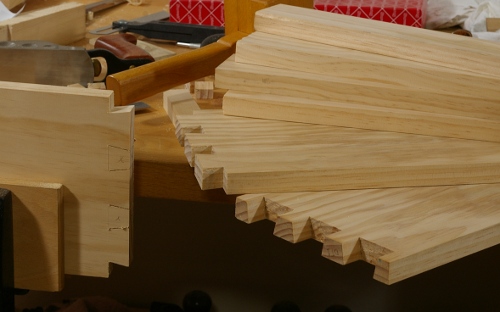
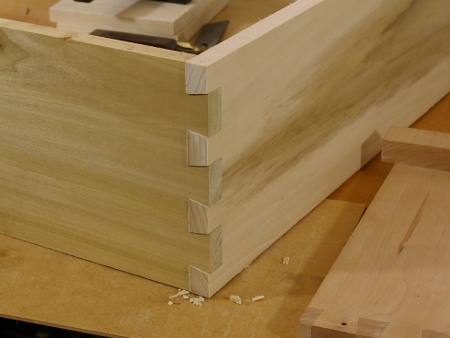
However, the story is not a sad one. For one, the joint is perfect; the only thing left to do here is plane off the proud excess at the ends of the tails and pins:

Another bright spot is that it went off without a hitch, even on pain-in-the-butt yellow-poplar sapwood (the lighter bits on the right). Saw, chop, and test-fit. The pins fit right off the saw; no paring was required on the sides of the pins. Thinking back to the first dovetail joints I made, it took much longer to cut joints that did not turn out as well. My speed is improving.

I’m back to using my cheap Crown gent’s saw, still with the same touching up of the teeth that I gave it when I first got it (slight jointing, filing with a needle file, slight stoning on the sides to remove some of the set, and wax). It works fine, though I can’t imagine how bad it would have been if I hadn’t tuned it. I am still plotting out the dream dovetail saw that I will make one day, but I’m too busy with furniture projects right now to get tied up with making another stupid tool, and honestly, it’s just not that important.

Sometimes I think of what could possibly make things move a little faster, and I came to the conclusion that some operations are actually going quickly but some not so quickly.

The fast ones are:

  • Sawing down the tails and pins
  • Removing the bulk of the waste
  • Test-fitting

The stuff that seems to take a little longer:

  • Laying out the joints
  • Paring down the final little bits in the tail and pin troughs

Now, I know that the paring could go a little quicker if I just bothered to make a pair of skew chisels. I really should get on that case some day.

What about laying out the joints, though? I do this mostly by eye now, marking out “what looks good” (to me, at least) for the tail spacing, then using a square and T-bevel to mark the lines. This works and it is St. Roy- (and others) approved. But it’s not fast for me. I can mark the spacing quickly enough, but lining up the T-bevel to the mark on top always seems to take a little extra time. A dovetail template could save some time, because you can register it to your marks at the top quickly.

But then again, we’re talking about a savings of only about two or three minutes here. And I don’t think it’s worth getting yet another tool for that at the moment. Furthermore, I can’t just arbitrarily pick the angle I want, as I do now. I know that’s been said a million times before, but I do think it counts for something.

Shoe Rack: Finished

Remember the shoe rack I’d been working on for a while? The one I haven’t written about for a while? Well, it’s been in the finishing stage for the last month. I did a tung oil/varnish blend first, and after waiting the requisite million years for that cure, I put on three more coats of varnish.

I started today by rubbing out the finish. That’s always pretty hard work. I used 320, 600, and 1500 grit sandpaper dry at first. In retrospect, the 1500 was not necessary, because I hit it with #000 and #0000 steel wool lubricated with mineral oil afterwards. Why do I always forget what an amazing difference that makes? I did not use rottenstone as a final step this time, because this is a shoe rack and does not need a super-fine glassy finish.

Then I set out drilling holes for the assembly hardware. The sides were relatively easy–just pop them under the holdfasts, mark out, and go crazy with the brace and bit:

(Yeah, Dan, that’s one of my Millers Falls #2 eggbeaters on the right. It’s got a countersink chucked in. Just sayin’, ‘cuz it seems to be eggbeater season.)

The shelves were a lot trickier. I had to bore parallel into the stretchers for a place to insert the screw-in nuts. That’s difficult to do without splitting the wood, so here’s my solution. With scraps protecting each side, one end goes in the vise, the other is held tight with a handscrew:

So what hardware am I using, you ask?

It’s the same kind I used for my saw handles–those furniture connector bolts with the really wide heads that are screwed in with hex drivers. (I like these things, obviously. Very 20th century, I realize.)

Then it was time to see if everything went together okay. It did:

Oddly, it looks just like I wanted it to. Not so oddly, it’s already full. The SO had a job to do here, you see.

Saw Till: Dovetail joints, pieces

While waiting for the first coat of finish on the shoe rack to cure, I milled the pieces for the saw till down to size in preparation for the joinery. So far, I’ve only had time to finish one through dovetail joint, and get part of the way through the tailboard on the second:

The completed dovetail joints are on the bottom right (pinboard on the bottom, tailboard above it), and the new tailboard-in-progress is on the left. The other four pieces on the upper right are for the stretchers.

The pinboard (which will form the lower shelf) presented a small problem before I started out. I hadn’t noticed before, but it wasn’t really flat. So I thought about it, and flattened just one face square to the edges with my jack and jointer planes. In theory, the joint will be fine because the inside face is now flat–that’s the one you need to be square to the sides.

I cleaned off all of the surfaces with my smoother plane as well. I felt that it was probably a good idea to do that work on the inside faces before cutting the dovetail joints. I should have probably waited on the others, because I’ll probably need to do them again after I cut everything, but oh well.

It’s been a little hard to gauge my progress with these dovetail joints. I’m managing to cut them precisely, requiring practically no paring, but I feel that I may be cutting them rather slowly. It’s also been hard to find the time to work; I’ll only get 20-30 minutes at a time to work, then I have to do something else, like go to the unfortunate day job.

This wood, whatever it is, is pleasant to work with. I guess it’s Ponderosa Pine. Working is similar to Yellow-poplar. I’d like to find a good source of it, I think. My recent experiences with softwoods have been positive, which is interesting, because I never imagined myself using them much. They present challenges for your tools, sure, but they also seem to have a lot to offer.

This almost certainly won’t be done by the time I leave for a short trip to Pennsylvania this week. But the good news is that I’m going to Pennsylvania!

Saw Till: Plan

Eventually, everyone seems to build their own saw till, and I’m no exception, because that’s what I’ve been thinking about as I finish up the shoe rack. So after the requisite internet research (think Dan and company), and taking a million measurements of my saws, I have a plan for my own. It’s nothing fancy, but it is at least less silly than my tool rack:

These are the side and front views here, I suppose. The rest of the drawing, not shown, contains labeled component parts. I must apologize for how little this looks like a three-dimensional piece; I know how it’s supposed to look because I drew it, but that doesn’t help you much. Unfortunately, Google SketchUp isn’t available for Linux, so I’m using Inkscape. Oh well.

[Update: Here is the SVG file for the plans. You can download it; Illustrator, Inkscape, and other programs will edit it. You can view it in Firefox.]

Some of the features here include:

  • Open top, in case I get a 38″ King-Kong-sized saw or something.
  • Shelf on the bottom, for saw sets or dust.
  • Dovetailed bottom.
  • Wedged through tenons. I was on the fence about this, until I realized that I’d never done through tenons before, and that this would be a great project to screw them up on.
  • Optional small panel for the shelf.
  • Design requires just seven components.
  • Possible use of hardware for interchangeable slots.

I’ve got the side sections to width and length already.

Shoe rack: Components completed

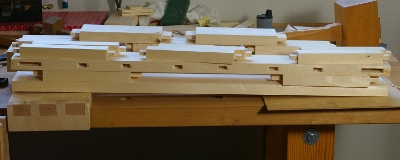
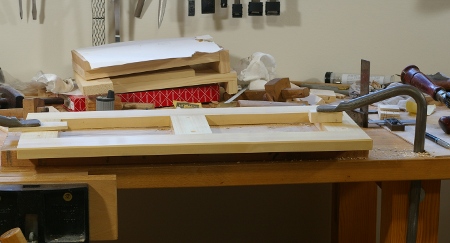
I finished cutting all of the joints for the shoe rack today. It didn’t take very long to finish the remaining mortise-and-tenon joints. So now I’m left with some glued-up frames and a stack of pieces, ready for glue-up:

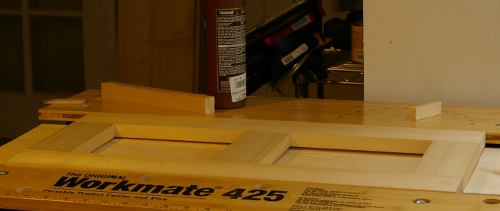
Because there are so many pieces, the shelves are trickier to glue up than the sides. But it wasn’t that bad of a job. I used the same technique as the sides. That is, put the pieces on one side mostly in place, put on the other side, bang on it a little to bring the joints closer together, then throw it in the Workmate and clamp tight.

Good to see that the Workmate is finally getting some real action.

Shoe Rack: Shelf components and side glue-up

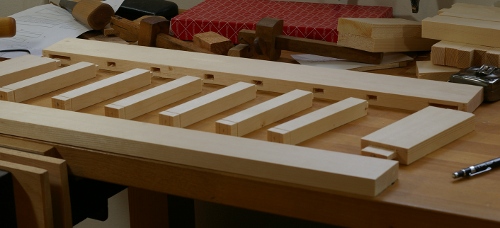
Although I didn’t have much time to work this weekend, I did make a little progress on the shoe rack. The shelves are coming along; in the following image, the mortises for the small stretchers are all complete, as are half of the tenons. The other half of the tenons are marked out and ready for the saw.

There are 18 of these small stretchers, which means 36 more mortise-and-tenon joints, but they go pretty quickly at this size (about 1/2″ square face size for the tenons).

I also picked up some liquid hide glue and glued up one of the side frames:

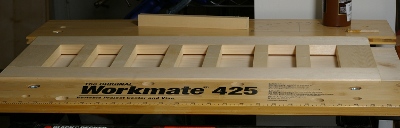
The Workmate doesn’t seem too bad for this operation. With some fooling around with the bench’s panels, I was able to clamp it between the jaws. Using the liquid hide glue (Titebond in this case) was about as easy as you’d expect–squeeze it out, spread it on the joint, and clamp. This is good, because without a heat lamp or something, I don’t think I’d be able to use hot hide glue in the shop because it’s just too cool down there to have any sort of reasonable open time for glue-up operations that involve more than a handful of joints.

There isn’t much left to do on this project. I need to cut the rest of those small joints (24 left), glue everything up, and then apply some sort of finish.

Shoe rack: Side frame

At this point, most of the significant work on the shoe rack’s joints are done. the side frames are complete, with both consisting of six mortise and tenon joints like this:

In addition to this, there are three shelf frames that are on their way to completion. They’ll take just a little more time to complete, but all of the boards have been cut and now it’s just a matter of making 36 more joints. This sounds worse than it actually is, because the mortises and tenons on the remaining joints are quite small.

I have made a few decisions on this project. The first is that I’ll use some sort of bottled hide glue for the joints to see how it works. The second is that this will be a knockdown project and I will use some fastening hardware to attach the sides to the shelves. These decisions reflect a desire to experiment a little more, while at the same time saving some time, because this thing really needs to get done so that I can move on the the next project.

I also figure that since this is not meant to be the finest piece of furniture in the land, it doesn’t matter too much if some flaws show up a couple of years down the road. This became even more so when, a few weeks ago, I saw a design I liked a lot better than my current one.

Shoe rack: Side frame pieces

I’m in the process of making a shoe rack. It will basically be two side frames with three shelves, all done with mortise-and-tenon joints. I have most of the wood dimensioned, and have the boards for one of the sides cut to length now:

There are going to be quite a lot of mortise-and-tenon joints in this project. I’ve been practicing, and am getting much better. The fun part is that I’m no longer using the “drill and chop out” method of making the mortise. Now that I have no more downstairs neighbors, I’ve just been chopping the whole thing out with a chisel. It’s noisy and destructive and a lot faster than fooling around with the drills.

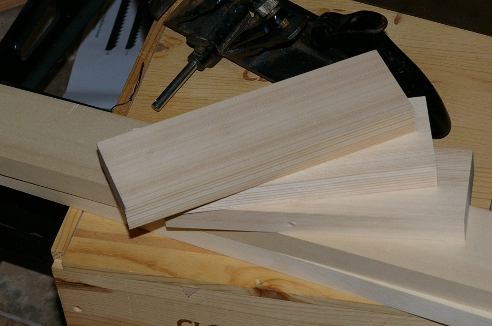
This wood is some rather cheap mystery softwood. These boards have a lot of knots in them; in fact, they’re downright tragic if you look at them whole. However, if you buy 10- and 12-inch widths, you get a lot of sections that have clear wood, and you can get cuts that are quartersawn in this way. This is a pretty common trick with softwoods.

The growth rings are very closely packed in some of these boards, but it’s still a rather soft wood, somewhere around the toughness of yellow-poplar (tuliptree). It’s always kind of tricky to make joints in wood like this, but I must admit that there’s a bit of a charge when you succeed.

Crepe spreader

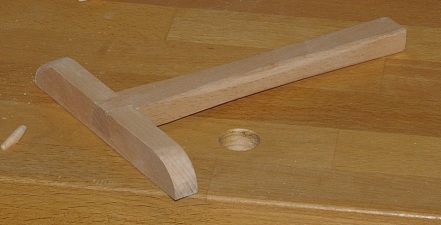
Here’s a quickie project for a co-worker, a crepe spreader. It’s 5×7 inches.

It uses a sliding dovetail joint to connect the two parts. The joint came out better than I expected but I don’t think I will use it for any future crepe spreaders. A wedged through mortise and tenon seems like it would work better.

It’s pictured without a finish. I’m going to give it a very light once-over with some sort of oil (probably olive oil) just to make the surface a little easier to clean after use. Otherwise, it’s not worth really giving it any sort of extravagant finish because it will see a fair amount of wear anyway.