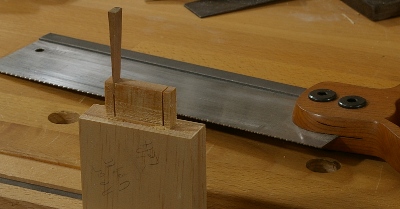
This is a relatively simple part of a wedged through tenon joint to make, but I was still wondering one thing about the kerfs where the wedges will be driven: How far from the ends of the tenon should they be? So I looked around to see if Korn had anything to say on the matter. He writes that it should be no more than a quarter-inch from the end, and made with a relatively thick-plated saw. So I decided to go to about 3/16″, and test to see if a wedge will fit into the kerf initially (without banging it in). Seems okay:
I opted not to drill the holes at the bottoms of the kerfs that another book says to do (I think this might be helpful if the wood were harder).
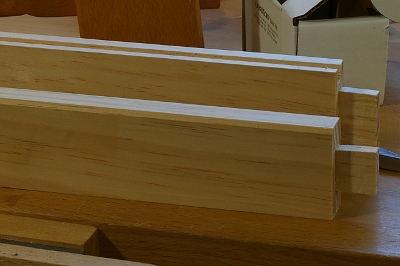
Then I did the other seven tenons, and I now have four stretchers ready to go:
Well, that’s nice. All of the saw till parts are now ready for assembly. In preparation, I also removed the huge layers of rust from a couple of heavy Hartford Clamp bar clamps (estate sale find) so that they won’t “rub off” on me or the saw till during assembly. About the only thing I don’t have are some cauls for the work, but I have plenty of scrap.
I’m almost ready to glue up the saw till, but a few small details remain. Ten of them happen to be the little wedges that I’ll drive into the tenons at the end, so I sawed them out today. I decided to make them out of a little scrap of apple I had lying around in a box. The first step was to saw out the little sliver of the wedge shape:
And then, I had to cut the wedges to width:
For various reasons, this took a lot longer than it really should have. I had a really hard time holding this stuff steady as I was sawing at first, even with the bench hook. The scrap was too small to get a decent grip. The hook wasn’t at a good height (eventually solved with that riser block on the second photo).
There were also many checks in the wood, because this piece came from the end of the board. I convinced myself that this was okay, because the fibers only need to hold together until I insert them into the tenons and bang them home.
These wedges did eventually come out of the process:
The disheartening part was that after all of that work in the morning, I still didn’t have as many as I needed, so when I came home, I went to work until I had enough. I need ten of them, so I decided that I’d stop at thirteen.
In other saw till news, I cut a groove around the inside surfaces of the bottom back (on the sides, the bottom, and the lower stretcher). I also chamfered the edges that the saw handles will rest on.
The saw till is coming along now. I finished the dovetails before I left for my trip, but didn’t have a chance to work on anything else until I got back and started to get over the stupid cold I managed to get while I was in PA.
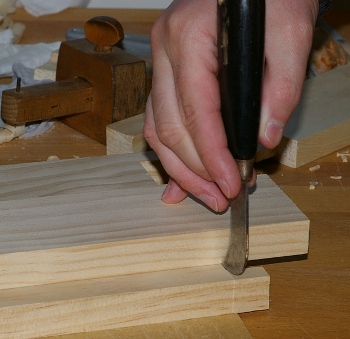
Yesterday, I had some extra time, so first, I reworked the shape on my mortise chisel because it was a little skew. Being laminated, it is easy to shape despite its huge size. Then I got down to business, making the first through mortise ever with that chisel:
Hey, that didn’t turn out so bad at all. Admittedly, I was a little more careful in setting up the mortise marking gauge this time. A little more care is in order for this wood, because it’s so soft that you can really dent it up if you’re not careful. Otherwise, you just do it the way everyone tells you to: Mark on both sides, chop halfway through, turn around, and chop the other half. And don’t chop the ends until you’re about finished.
With mortise angst out of the way, it was time to move on to tenon angst. The first one on a stretcher is easy. The second one is a little harder because you have to get the stretcher length just right. I marked the baseline from the dovetail pinboard (rather than measuring):
Yep, that’s the humiliating marking knife again. Not too optimal for this particular mark, but at least it worked.
(I also marked the mortise locations on the second board from the first, it seemed a lot more reliable than measuring.)
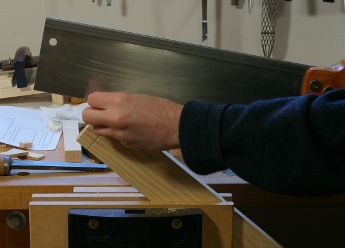
Then it’s off to the races with my new tenon saw:
Holy cow, look at how much camera time my hands are getting in their debut photo shoot. Well, I always told myself that if all my usual career options were dead, I’d still have the hand model option to fall back on.
With one stretcher done, it was time to do a test fitting of the pieces completed so far to make sure that everything was square and decent-looking. Shockingly, it was.
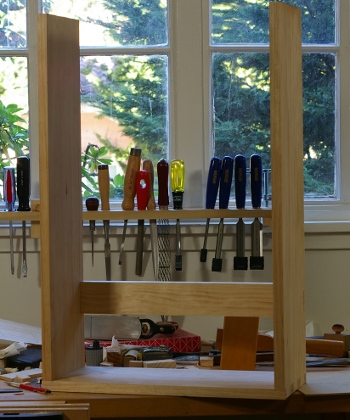
Woo, check out those stylin’ plastic-handled chisels. Well, I’m not sure how I feel about this. I know I need a few more chisels and I really like a lot of the old ones I’ve tried, but the ones I have work fine for now, especially the yellow Lee Valley ones. I even have a few old ones that I like, they just need handles and sharpening, but I’ve just been too lazy to get them in order.
Lately, I’ve been trying to visit PA every fall, when the weather is nice and the leaves look good. This year, the weather was not so great most of the time, but there were some nice spots and we did get to do some hiking around. This hiking, it’s fun not only because the leaves look really nice, but you also get to see the trees where your wood comes from.
One of the more interesting places was David’s Vista up on the Jackson Trail by Pine Grove Mills (near State College). It was there where this tree shows how a ridgetop tree weathers:
There wasn’t really much burl here, but the cambium layer has definitely been twisted around the crotch area between two branches. Talk about reversing grain! As to what kind of tree it is, there was a red oak growing out the side of this, if I recall, so that might be a good guess (even though everything else in the background was a pine).
Other sights from the trip include the vista itself, some leaves collected on Mt. Nittany, and leaves from one of the chestnuts growing on Mt. Nittany:
And now it’s time to get back to work here at home.
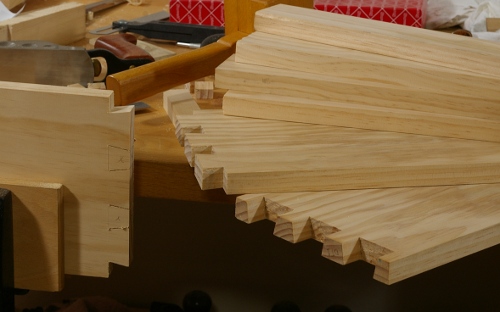
While waiting for the first coat of finish on the shoe rack to cure, I milled the pieces for the saw till down to size in preparation for the joinery. So far, I’ve only had time to finish one through dovetail joint, and get part of the way through the tailboard on the second:
The completed dovetail joints are on the bottom right (pinboard on the bottom, tailboard above it), and the new tailboard-in-progress is on the left. The other four pieces on the upper right are for the stretchers.
The pinboard (which will form the lower shelf) presented a small problem before I started out. I hadn’t noticed before, but it wasn’t really flat. So I thought about it, and flattened just one face square to the edges with my jack and jointer planes. In theory, the joint will be fine because the inside face is now flat–that’s the one you need to be square to the sides.
I cleaned off all of the surfaces with my smoother plane as well. I felt that it was probably a good idea to do that work on the inside faces before cutting the dovetail joints. I should have probably waited on the others, because I’ll probably need to do them again after I cut everything, but oh well.
It’s been a little hard to gauge my progress with these dovetail joints. I’m managing to cut them precisely, requiring practically no paring, but I feel that I may be cutting them rather slowly. It’s also been hard to find the time to work; I’ll only get 20-30 minutes at a time to work, then I have to do something else, like go to the unfortunate day job.
This wood, whatever it is, is pleasant to work with. I guess it’s Ponderosa Pine. Working is similar to Yellow-poplar. I’d like to find a good source of it, I think. My recent experiences with softwoods have been positive, which is interesting, because I never imagined myself using them much. They present challenges for your tools, sure, but they also seem to have a lot to offer.
This almost certainly won’t be done by the time I leave for a short trip to Pennsylvania this week. But the good news is that I’m going to Pennsylvania!
Eventually, everyone seems to build their own saw till, and I’m no exception, because that’s what I’ve been thinking about as I finish up the shoe rack. So after the requisite internet research (think Dan and company), and taking a million measurements of my saws, I have a plan for my own. It’s nothing fancy, but it is at least less silly than my tool rack:
These are the side and front views here, I suppose. The rest of the drawing, not shown, contains labeled component parts. I must apologize for how little this looks like a three-dimensional piece; I know how it’s supposed to look because I drew it, but that doesn’t help you much. Unfortunately, Google SketchUp isn’t available for Linux, so I’m using Inkscape. Oh well.
[Update: Here is the SVG file for the plans. You can download it; Illustrator, Inkscape, and other programs will edit it. You can view it in Firefox.]
Some of the features here include:
Open top, in case I get a 38″ King-Kong-sized saw or something.
Shelf on the bottom, for saw sets or dust.
Dovetailed bottom.
Wedged through tenons. I was on the fence about this, until I realized that I’d never done through tenons before, and that this would be a great project to screw them up on.
Optional small panel for the shelf.
Design requires just seven components.
Possible use of hardware for interchangeable slots.
I’ve got the side sections to width and length already.
The last saw to be complete from the pile o’ handles I refinished a while back was a 28″ Disston D-8. The plan was to make it a replacement for the 7 TPI D-7 that I’d been using for a rip saw.
When I first got the D-8, I was somewhat ecstatic. The blade was pretty clean, reasonably straight, and even had its etch. So all I needed to do was refinish the handle, clean off the blade, and sharpen. Easy, right?
Well, I got to sharpening, and about halfway through from the heel to toe, my file started to make strange noises and didn’t want to cut the metal. Huh. It turns out that there was a roughly 8-inch length where someone had done something unholy to the teeth. They were hard, very hard. We’re talking “breaks the teeth off your file” hard here.
I wasn’t going to let a saw make a monkey out of me, though, and managed to work through the hard metal. It seemed to go about 1/8″ deep into the blade. After this, I was tired. Very tired. I thought, well, maybe I should name this thing “Sawzilla,” but quick research indicated that it wasn’t a terribly original name. So here is Sawthra, named after the slightly more obscure Mothra:
The Disston D-8 brings me to another thought I’d been having lately, namely, “wouldn’t it be great to have a brand-new D-8?” Then at Bagathon, I made a rather unusual deal with Larry that brought me this saw:
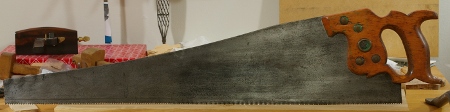
Notice anything familiar about this 24-inch Pax “No 1” panel saw? Like, maybe, that it’s a total copy of the Disston D-8, even down to the handle and the screw arrangement?
So I really do have a practically brand-new D-8 now. It makes sense, I suppose. The Flinn company tends to catch a lot of flak about its saws, in particular, that the handles aren’t as nice as century-old handles. But they do at least reproduce a true classic handsaw. The blade is taper-ground, for whatever that’s worth. Although I wouldn’t characterize the teeth on this thing as “sharp” (my little carcase saw currently cuts faster than this thing at the moment), they don’t look too bad, and probably need a little touch-up. I’ll wax the blade, like I always do.
The handle? Well, I’m not sure if I want to make a new one or not. To be honest, the handle isn’t that bad. But I always seem to end up making handles.
Looking through my past posts, it seems that I forgot to post when I finished a couple of smaller projects.
First, remember the tenon saw handle that I’d been working on for nearly a year? Seriously competing for the world record of “longest time taken to get a saw handle done,” I finished it about a month ago and completed the saw:
It’s a 16″ blade, somewhere around 10TPI, if I recall correctly. I used it for the larger tenons on the shoe rack project. It took some getting used to, but I like it a lot. Larger saws such as this seem a little strange to use on tenons such as the 1.5″ x .75″ ones on the shoe rack, but it works fine.
The other little thing I was working on was a small tool rack to hold chisels and similar tools behind the workbench. I agonized over this for no good reason, looking at every tool rack I could find on the web and in books. Finally, I just slapped one together in about a half an hour:
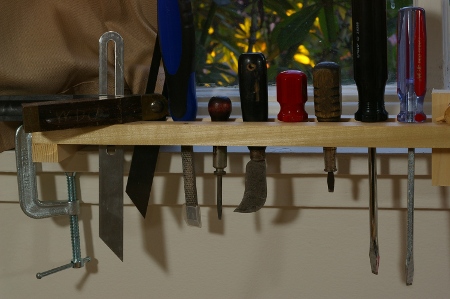
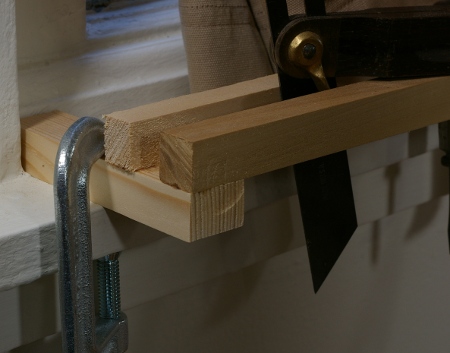
And when I say “slapped together,” I mean it. The preceding photo doesn’t really illustrate how hard I’m trying to get the title of “lamest joinery ever seen in a tool rack,” so let’s get a closer look:
Yep, the rack consists of two long pieces of yellow-poplar/tuliptree not really even lap-jointed onto two small pieces of mystery softwood. I just planed them flat, put on some glue, and clamped tight.
The whole thing is fastened to the windowsill with two c-clamps. That’s partly because I’m being lame, but also partly because we rent this place and I don’t want to go around putting holes in everything in sight.
The important part about this is that it actually works; I finally have most of the junk off the workbench. It works so well that I’m considering making a second equally lame example.
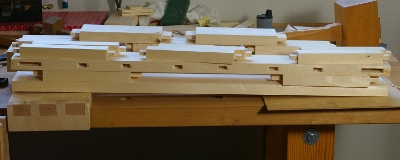
I finished cutting all of the joints for the shoe rack today. It didn’t take very long to finish the remaining mortise-and-tenon joints. So now I’m left with some glued-up frames and a stack of pieces, ready for glue-up:
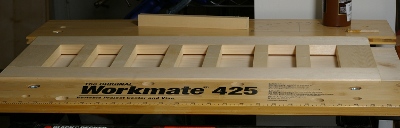
Because there are so many pieces, the shelves are trickier to glue up than the sides. But it wasn’t that bad of a job. I used the same technique as the sides. That is, put the pieces on one side mostly in place, put on the other side, bang on it a little to bring the joints closer together, then throw it in the Workmate and clamp tight.
Good to see that the Workmate is finally getting some real action.
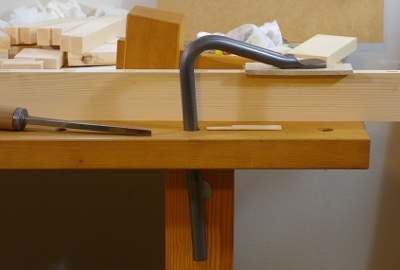
The recent Bagathon gave me a chance to fool around with some of the Gramercy holdfasts (thanks, Kirk), and the Lee Valley/Veritas hold-downs (thanks, Larry). I don’t really know what took me so long to try some, but there they were. I liked both of them, and probably the Veritas version is a bit stronger (and doesn’t require a mallet), but it costs $75 for one of those versus about $32 for a pair of the Gramercy holdfasts. So it was off to the Tools for Working Wood site last week.
They arrived today. So let’s do a quick rundown of what I was using before and how the holdfasts compare for a couple of operations.
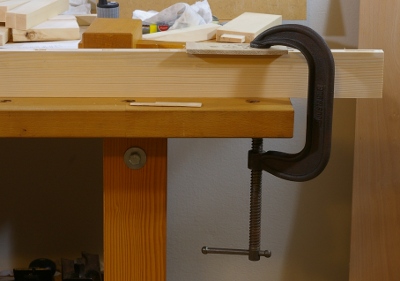
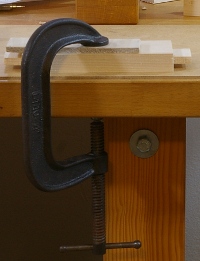
For mortises, I was using a c-clamp to hold the work to the table:
It’s really strong, but your bench can’t be too thick, you can’t have an apron, and your work can’t be too big, or you’ll need a bigger clamp.
The holdfast provides more flexibility in positioning the work, and it’s a bit easier to set up than a clamp.
It’s not quite as strong as the clamp, at least not in a benchtop of this thickness (1.5″), but it still works fine.
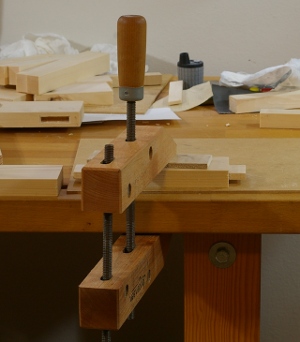
For touching up tenon shoulders, I was using a handscrew in this configuration:
This requires a bit of fiddling, but it’s a little easier to position than the c-clamp. However, the work doesn’t always level so well, especially with narrower pieces. In addition, there’s a lot of stuff in the way. About the only advantage is that it’s easy to remove.
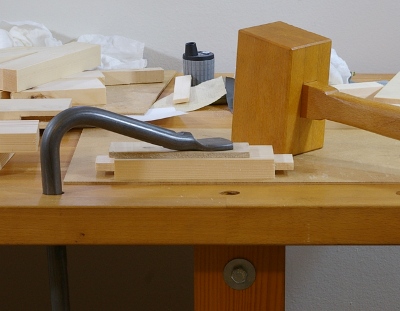
The holdfast is a great improvement. There’s far less stuff to obscure you while working, and it sets up in a flash.
I’ve also used a c-clamp for this. In this configuration, it’s even less preferable because you not only have to do a bunch of fooling around under the bench, but also have to do a lot of fooling around under the bench near a leg.
All of this is starting to lead to a question of where to put all of my bench accessories, because by now, I have a bench hook, shooting board, two holdfasts, a zillion little bench dogs, a Veritas Wonder Dog, and a few other little things, and I do have a few more things on my list. Should I see if I can make that second shelf under the bench, and if I do, will that interfere with the holdfasts while they are in use?
Oh well, I guess I’ll figure it all out in time. For now, I have to complete the shoe rack (finished two rows of mortises and a row of tenons today!).












 Galoototron