Stool: Glue-up

While waiting for the glue to dry on my botched-mortise fixes, I broke the edges on the leg frame with sandpaper. I did this moderately, not taking off too much, but more than just a light touch.

Then I chamfered the edges of the top. The more I use the chamfer attachment to my Veritas low-angle block plane, the more I like it. It’s not the easiest thing in the world to control at first, but by taking light strokes (and starting at 1/4 to the end of the cut and working your way back as you would a moulding plane), it does a nice job. Not to mention that it has an adjustable mouth.

With no excuses left, I had to face the dreaded glue-up task. This part is always a little intimidating to me because you actually have to make sure that you get it done reasonably fast, and I normally like to work slowly. In addition, I’m even more clamp-challenged than most woodworkers.

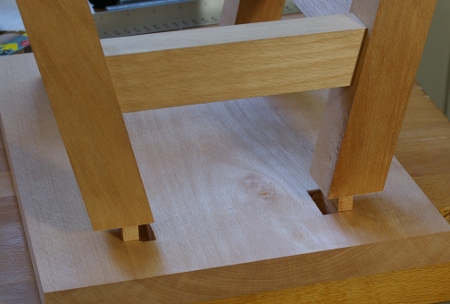
One thing in particular that worried me was that my joints were very tight; it was difficult to insert and remove the parts without any glue. So how hard would it be to jam these things in?
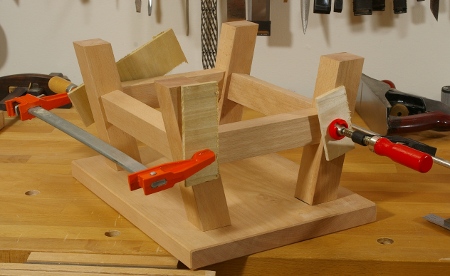
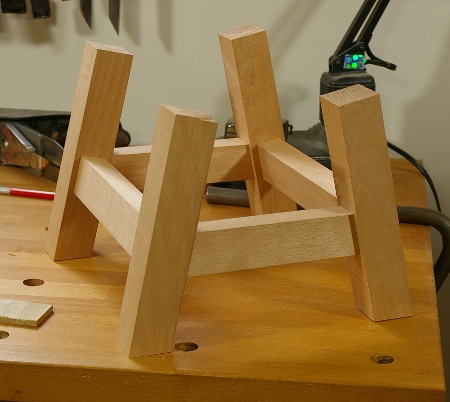
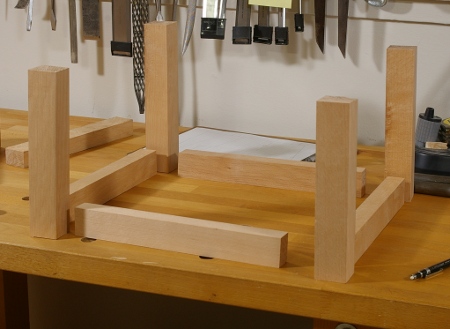
So, from the preceding photo, you can not only see that I managed to get the joints together, but I needed only two clamps! The frame pieces went together like butter; it seems that the hide glue acted as a little bit of lubricant instead of being an impediment. The only time I really had to use some force was driving one of the legs all the way into the top. I called upon my mallet to do that.

I’m not even sure that these two clamps were necessary. The joints were really holding together tightly, perhaps because of the overall structure.

Will I dare try stepping on this thing tomorrow?
Stool: Messing Up and Repairing Mortises (again)

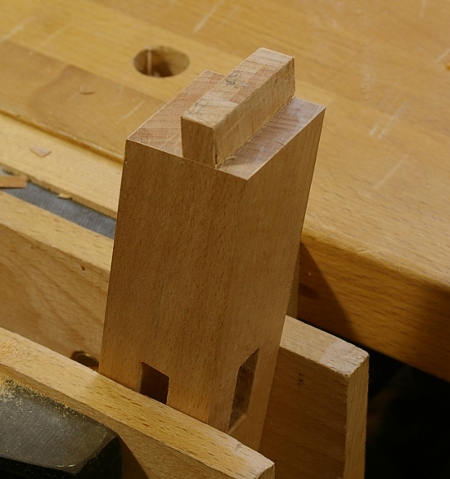
In preparing to attach the stool’s top to the leg frame, I first measured, marked, and cut angled tenons on the tops of the legs. I used the scale drawing again as a guide. Here’s a photo of an angled tenon before I finished cutting the shoulders at the long ends:

That was a fairly simple task, even though I was cutting the tenon before the mortise. To make sure that the tenon fit, I chopped a mortise in a piece of scrap and test-fit.

Then I assembled the frame and double-checked the distance between the tenons, and carefully laid out the lines that I’d chop against on the stool top. Then I broke my mallet chopping the mortises (as described in the preceding post), so I had to wait for the glue to set on the mallet repair until I could get going again. When I did, I was excited to see a test fit.

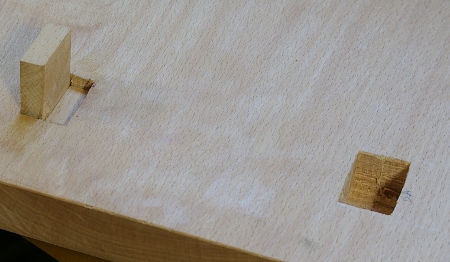
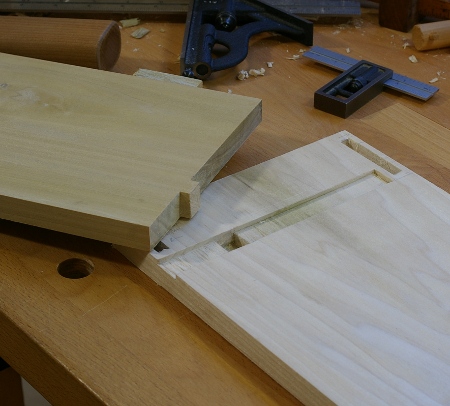
I was not so excited to discover my latest boneup:

Arrgh. I had chopped the mortises on the wrong side of the lines. I have got to get more careful with this. It’s, what, the third time I’ve done that in two months? I was pretty discouraged, so I took a break while I tried to figure out what I would do about it. Also, I was hungry.

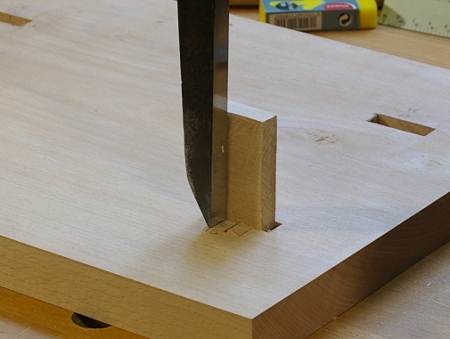
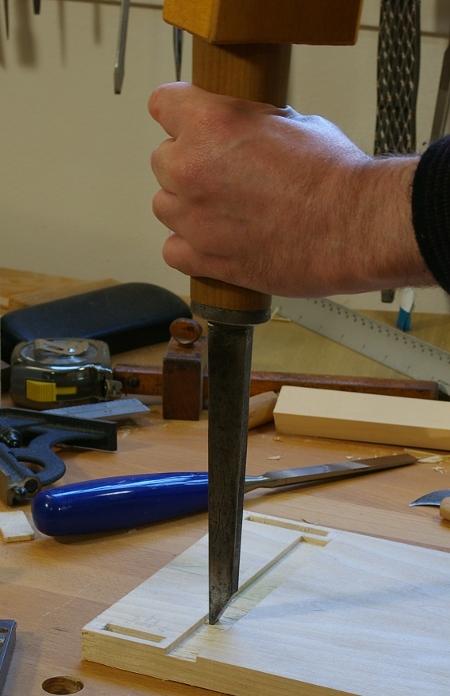
Then I went back to the shop and cut out a piece of beech to the same thickness as the tenons. I inserted this into the mortise, and then extended the mortise (this time in the correct location) by chopping against the side of the inserted section:

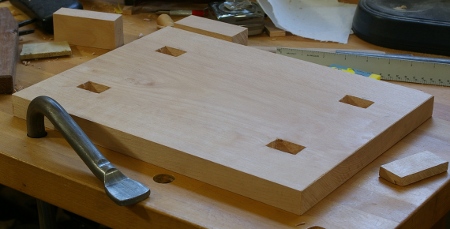
After doing this for all four mortises, I had the following:

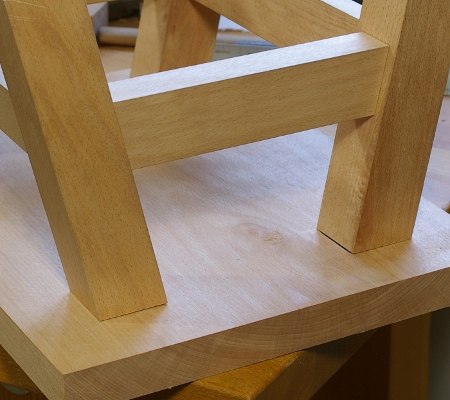
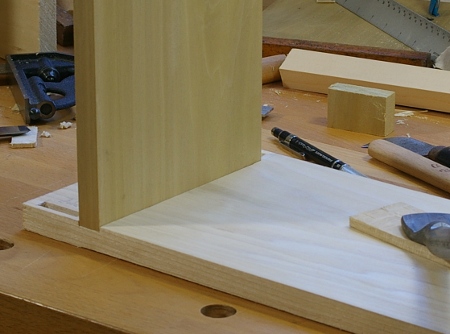
And then I did a test fit to make sure that I’d actually chopped them in the correct place this time:

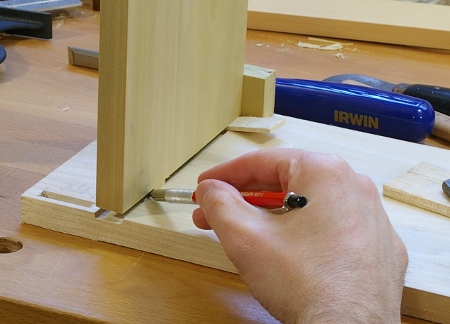
Phew. It fits, and there’s only a small void showing on the underside of the stool. But if left and glued up like this, there would probably be a tendency to rack, because the legs could conceptually slide around. Therefore, I had to fill in the originally-cut side of the mortise.

I sliced off a small section of the piece of beech I used to register the chisel when chopping the correct mortise, and glued that on one side where I’d originally chopped the mortise. Then, on the other side, I inserted the section again to “clamp” it in place as the glue dried:

After each mortise got its repair, I did another test fit. Incredibly, it seems to have worked. Now I just have to finish off the edges on the components and glue up.

Stool: Frame Joinery Complete

I managed to get a chunk of shop time in today, and finished the remaining mortise-and-tenon joints in the components that make up the stool’s frame.

After doing all of the angled joints first, I found myself relieved when I got to the normal mortise-and-tenon joints. The tenons aren’t any more difficult to cut on the angled joints, but you do have to pay attention when making the mortises. The normal ones are blissfully mindless, which probably explains how I managed to chop a mortise in the wrong place again. I was able to fudge a way around that error. One of these days, I’m going to learn to be careful where I put those things.

With each of the joints complete, I made a test-fit, and it looks like everything works out pretty well:

The only remaining work to be done here is to cut the top to its final size, and then to attach the top to the legs. That latter part will involve angled tenons, yay.

I have been debating on whether I should chamfer the edges of frame pieces. I was originally planning to, but I kind of like the lines on this thing as it stands now.

Another debate is now if I should make a new mallet or not. The Thagomizer is a great mallet that has worked perfectly for me with the scale of joinery that I’ve been doing so far. However, for the first time, I found myself wishing that maybe I had a little more mass and leverage while chopping the larger mortises in this beech. If I ever do make one, though, it won’t be for a long time. I have too much to do.

Stool: Cutting an Angled Mortise and Tenon Joint

In my last post, I sawed the angle at the bottom of one of the legs of the stool. Now, I felt it was time to try one of the angled mortise-and-tenon joints with which half of the stretchers will be attached to the legs.

I again went back to my scale drawing and marked out where the mortise would go:

Unlike most of the joints I’ve made in the past, I couldn’t use one mortise gauge to mark both the mortise and the tenon. This is because a 1″ wide stretcher will meet a 1.5″ leg, so there has to be about a quarter-inch of space on either side of the stretcher so that it’s centered.

So I had to use a little bit of actual calculated measurement for this. Fans of the metric system may want to skip to the next paragraph. My mortise chisel is 3/8″, and half of that is 3/16″. The leg is 1.5″, or 24/16″, and half of that is 12/16″. That means that to center the mortise, I needed to align the near edge at 9/16″ (12/16″ – 3/16″). (Gee, I guess there was a good reason for not going with the 7/16″ chisel for this project after all.)

I used a marking gauge set at 9/16″ to scribe just one line for the mortise. From that point, it’s just like chopping a regular mortise, except at the ends. This mortise is not rectangular, but rather, a parallelogram. I used my sliding T-bevel to get the approximate angle on both ends while chopping.

The preceding image is actually a bit of a fib, because when I was doing this, my hands were switched (left on the chisel, right on the bevel), because I use the mallet with my right hand. I think you get the idea, though.

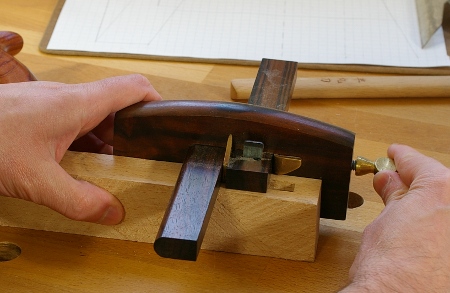
Next up was to saw the tenon. For this, I set up the mortise marking gauge. The first thing I did was to chop a mortise dead center in a 1″ width into a piece of scrap. Then I stuck the knives into the mortise and set the gauge:

Notice that this piece of scrap is roughly sawn on the face that you see here and it’s actually a little more than 1″ wide. This doesn’t matter, because the reference face of the scrap is flat, and I scribed a line at 1″ on the top, but I admit that it makes for a confusing picture.

Proceeding to the actual tenon, I went back to my scale drawing and marked out the limits of the tenon shoulder. When I had a mark in place, I used the sliding T-bevel again to mark the shoulder:

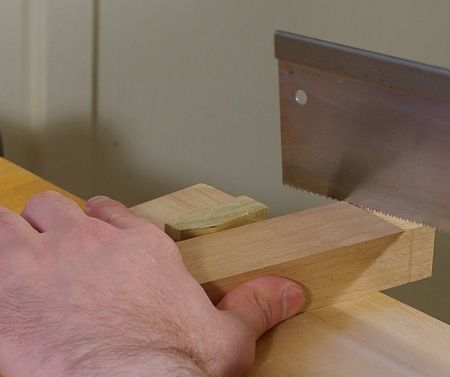
After using the mortise gauge set earlier, it looked just like almost any other tenon, except that the shoulder was at an angle. Sawing at angles turned out to be tricker than I thought, but then I remembered another tip from that book I mentioned in my last post; you can put a piece of scrap with one side relieved between the work and whatever you’re holding it against to bring it roughly square. This worked surprisingly well:

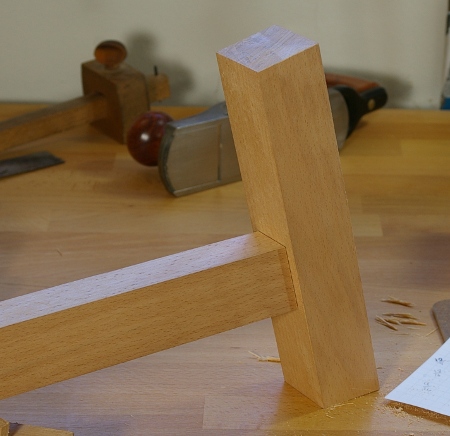
And soon, I test-fit my first angled mortise-and-tenon joint:

There’s a little gap in the joint in this photo; the test-fit revealed that I still had a little more trimming to do on the shoulder.

Three more of these plus four non-angled mortise-and-tenon joints to make, and the frame will be together, ready for its joinery to the top.

Stool: Setting Angles, Arranging Joints

To prepare for the joinery for the stool’s frame, I needed to come to terms with the angles at which I was going to set the angled mortise-and-tenon joints. Since I’ve never done one of these at an angle before, I felt that I might take a little extra time in preparing the various tools necessary to make the joints.

The first step was to create a full-scale drawing of the joint. Interestingly enough, a joinery book I have also says to do this, but I must confess that I didn’t read that before I’d gone through with the process. As I drew up this thing on graph paper, I realized that I had goofed up some of the critical marked measurements on the computer drawing, though the image of the stool itself was correct. I might go back and fix this in the image that I posted before, but I’ve got other stuff to do now.

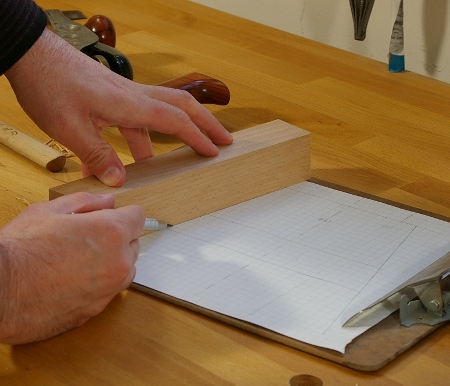
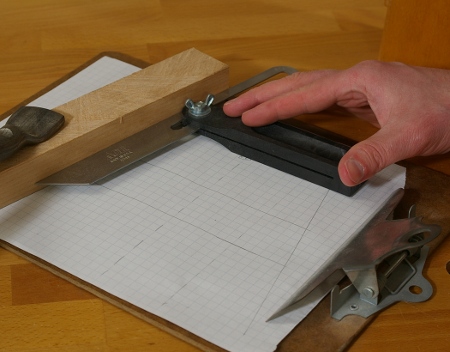
With the drawing on a clipboard and a straight board clamped to one side of the angle on the drawing, I set a sliding T-bevel:

After this was set, I realized that I was getting a little ahead of myself, because I hadn’t yet come up with an arrangement for the frame pieces. So I did that:

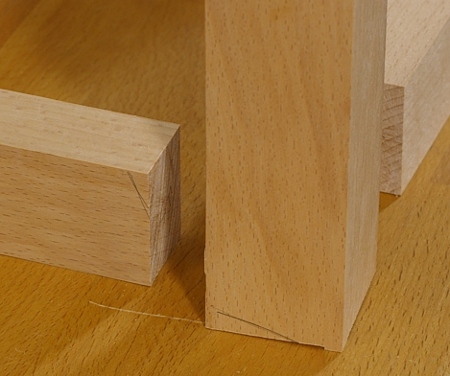
Then I marked each piece with its position. As an additional indicator, I also roughly marked where the wood will be cut at an angle, so that I don’t accidentally cut an angle where it’s supposed to be straight:

In the preceding image, the piece on the left is a stretcher, and the center is a leg, which will tilt to the left. The marks here indicate the way the stretcher will meet the leg, and how the leg will rest on the floor.

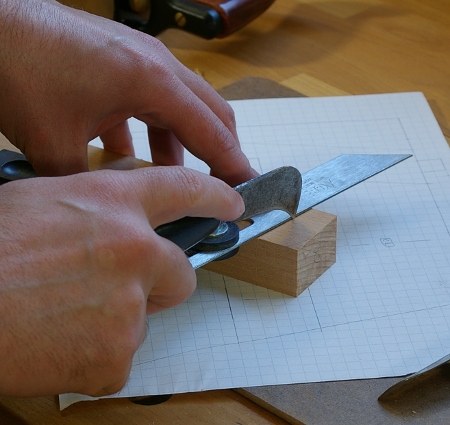
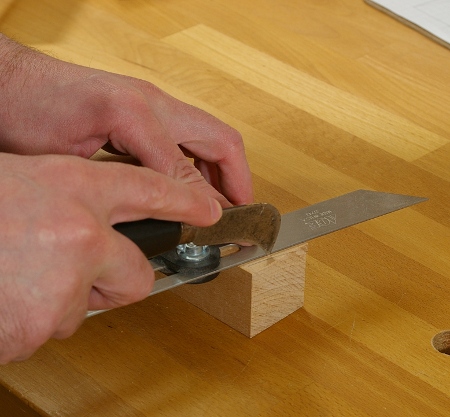
With all of this setting and marking done, I precisely marked the bottom of one of the legs with the T-bevel and a marking knife:

Finally, I sawed it. I don’t have a photo of that, but I guess you’ve seen pics of me sawing stuff before.

Next time, I’ll get down to the business of cutting the joints.

Stool: Plan, Milling Stock

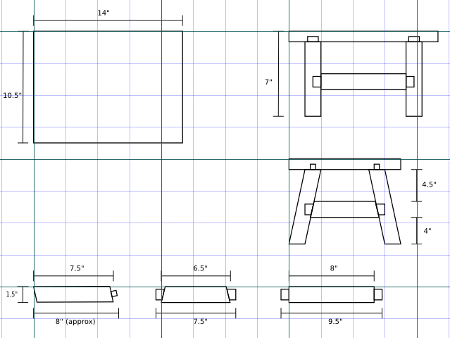
Now that the bookshelf prototype is glued up and ready for varnishing, I’m able to move on to my next project, which will be a short stool, essentially a single-step stool similar in spirit to the one that my great-great grandfather made. It won’t resemble his in size, wood type, or joinery; it will be adult-size and not use nails. Here is the general plan:

[Update: The plan is now available on the Plans and Guides page.]

I’ll make the whole thing from a wide piece of beech that I got last year. The top has already made an appearance here, although back then, it wasn’t flat, uniform, and smooth, as it is now. This board is 8/4 stock, but unfortunately, part of one side of a 2.5-foot section isn’t usable. After looking at the requirements for this project, I determined that this section contains enough usable wood, though I have to be careful where I cut. The legs will be 1.5″ square, and the stretchers will be 1.5″ x 1″.

Milling the legs and stretchers is a little more work than I expected. Because the board is quite cupped, and also because I’m trying to avoid some nasty parts of the board, I decided to mill each piece to thickness individually instead of the entire board at once. I’m first ripping out sections like this (notice the wedge in the kerf at the end):

You can barely see the nasty stuff I’m trying to work around in this shot; the discoloration at the upper right and a previous (aborted) attempt at trying to slice that stuff off.

After ripping, I have to flatten one face, square an adjacent face, saw some more, and plane some more. So far, I have one leg and one stretcher four-square. If I didn’t have the big saw, I probably wouldn’t even be that far.

Bookshelf: Gluing, Sizing, and Fitting Panels

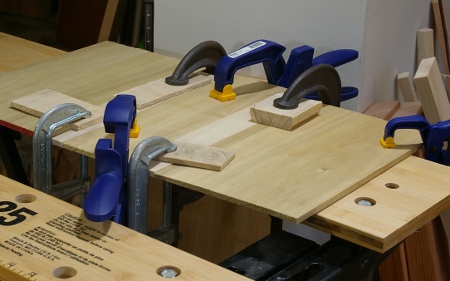
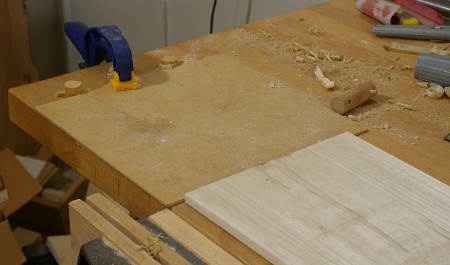
Getting panels glued up always looks sort of silly the way I’ve been doing it:

It works, though. Those little go-bar setups that luthiers like would be better, I think, but I’m far too lazy to make one of those right now.

While waiting for the (liquid hide) glue to set, I cut the grooves for the panel. With my mortise marking gauge and the same fence that I used for my original dovetailed box project, it was a lot less horrible than I expected. I still want a plow plane sometime, though.

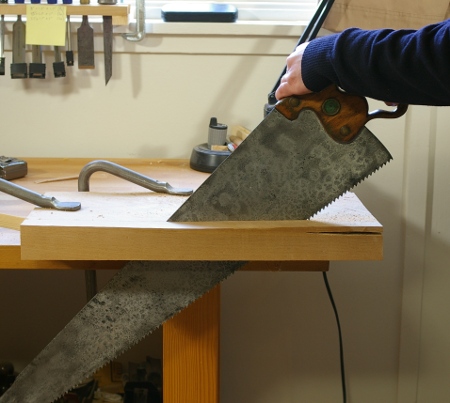
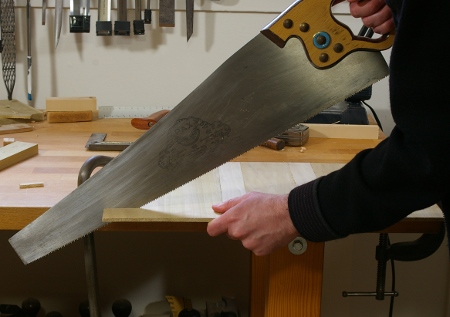
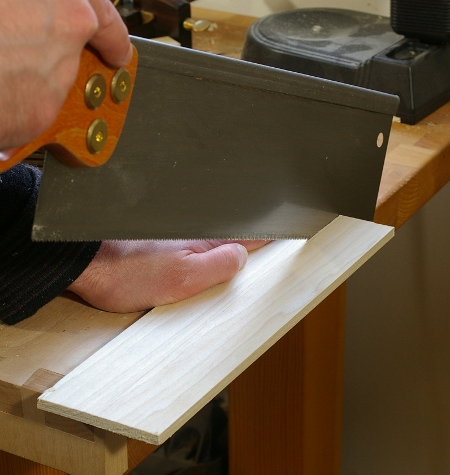
With the glue reasonably dry, I squared off one of the ends of a glued-up panel and sawed away:

Yep, that’s the Pax copy of the Disston D-8 panel saw that I noted in a previous post, now waxed and sharpened. This saw works nicely now.

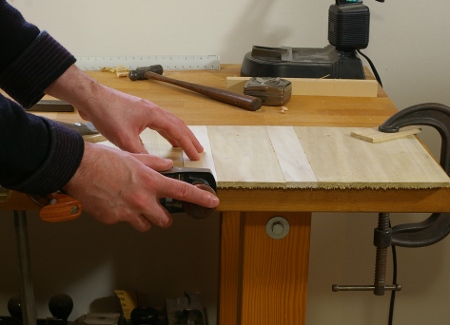
Of course, using this saw without a knife line on this wood will introduce a little tearout, so I had to clean it up a little. No big deal; it’s just another day in the life of my Veritas low-angle block plane:

After measuring out the height and repeating on the other side, it was time to mark out the width. In this project, those lighter strips are to be in the center of the panel, so I measured the final width from the edges of those strips. It was pretty simple arithmetic. Cutting to the width was a matter of using the tenon saw again (see the previous post).

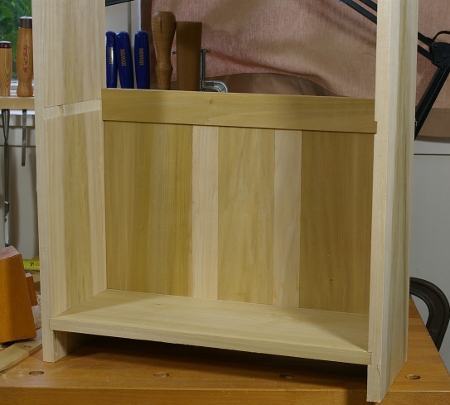
Then it was time to test the panels. The first one fit well, and the project was really starting to look like something:

The top panel, however, did not fit as well at first, because (for whatever reason) the back of the dovetail didn’t quite line up in the rear. To fix this, I used my side rabbet plane for the first time ever; I just widened the groove at the top of the side by a small amount.

I don’t have a photo of the final test assembly (hey, it would ruin the surprise, anyway). Glue-up comes next.

Bookshelf: Making Panels

The final components in the bookshelf are panels to go in the back. Recall from earlier that I used my frame saw to separate slices from the rest of the stock; those slices were to become the panels.

I’d been dreading this part somewhat because milling those panels down to size always seems to be kind of a pain. It’s not that they have to be flat (they don’t; stuff that thin bends to a certain degree), and it’s not that they have to be the same precise thickness (they don’t; you need only line up things on the face). It’s that holding the work in place without obstruction had always been a pain.

So I put in yet another dog hole and made this planing stop out of two dogs, a clamp, and a piece of hardboard:

It turned out to be not so bad. I think it would be even better if I put in some tiny brads at the end of the hardboard to grip the end of the panel, but I haven’t gone too nuts yet.

Another thing I did finally was to put some serious camber on the blade of one of my jack planes. Since I have four, it would be kind of silly not to try. I did this by just letting my Norton 220 waterstone dish out as I was grinding out a new bevel angle. That stone dishes notoriously, but in this case, it produced exactly what I wanted it to:

This really made the panel-milling process a lot quicker and a lot less work. Yay.

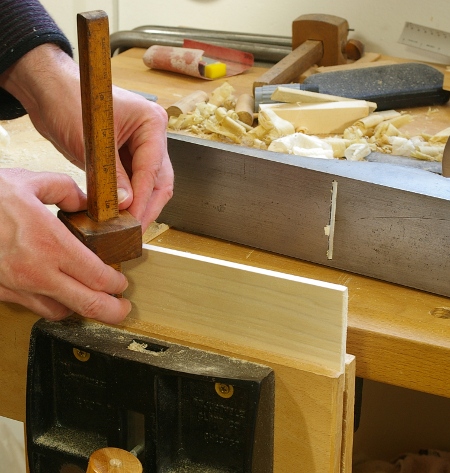
Once the pieces were milled, it was time to cut them into various kinds of strips and parts. This process is just like with any other kind of board; you first joint and mark:

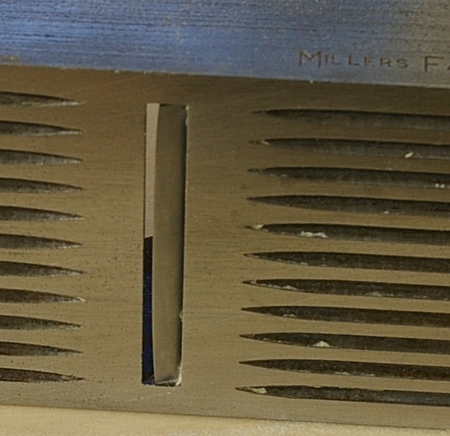
Then you get out some sort of saw, rip alongside the mark, and joint that straight. Check out the snazzy reflection of the wood in the saw here, the one that supposedly lets you know if you’re sawing straight:

When first approaching this task, I thought to myself, “A rip panel saw would be awfully nice right now, wouldn’t it?” But it turns out that the bigger tenon saw was actually a lot of fun to use on this thing.

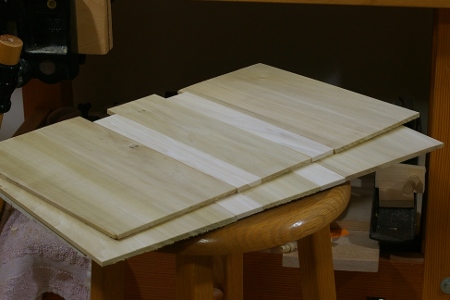
With everything cut to width and approximate length, I put the pieces in the arrangement in which they’ll be glued. It looks interesting, to say the least:

Whether it’s a good idea or not remains to be seen. I haven’t glued them together yet. Maybe tomorrow. I still have to plow the grooves in which these things will rest, and therefore, I still have the part where I wish I had a plow plane ahead of me.

(And yes, all of this because I’m not using plywood. No, I don’t have anything against plywood.)

Bookshelf: Modified Housed Joint, Part 2

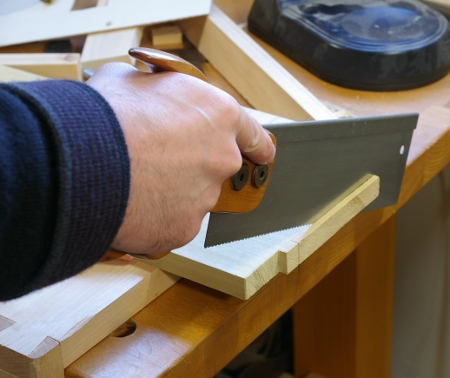
In the previous installment, I cut the dado for the housing, marked out the shelf tenon, and cut the tenon cheeks. The next step was to cut out the long shoulders:

It’s a little bit difficult to do this with this backsaw because it’s not deep enough to finish the cut, but I found that if you go as far as you can diagonally on both sides, it’s trivial to finish off with a coping saw. Something like a ryoba or thin panel saw would also work.

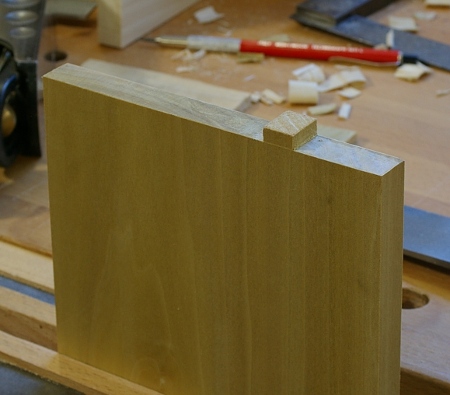
Here’s how the end of the shelf looks when trimmed and finished:

Now the slightly tricky part: marking and cutting the mortise for this little tenon. To mark, I put the shelf into the housing, registered where it needed to be registered, and used a lead holder to mark the lines at the bottom of the housing:

(However difficult this may look, it turns out that taking that photo was the most challenging part of this project so far.)

Then I removed the shelf, cleaned up the marks I had just made, got out the pigsticker, and started chopping away (but not too violently, since it’s not a through tenon):

Some paring was necessary to clean up the sides and bottom, as you’d probably expect.

That’s pretty much it. In the end, these were the final components:

And here is how it looks in a test-fit:

I also made the other three of these joints for the bookshelf prototype project today and did a test assembly. However, I’m not ready to glue up yet. There’s still a matter of the panels.

Bookshelf: Modified Housed Joint, Part 1

I finished with all of the stretchers for the bookshelf, meaning it was time to move on to the shelves. My original plan was to use a housed joint. I decided to make a small modification to the joint, though, to ensure that the bookshelf would resist twisting forces. The modification is basically just a small mortise and tenon hidden inside the joint.

The hitch is, of course, that I’ve never made a housed joint before, so I set off on a test on some of the cutoffs from the projects. Surprisingly, that actually went well, so I proceeded to the first of four “production” joints.

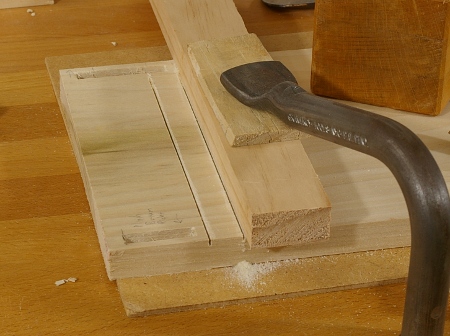
I started with the dado housing. First, I squared a knife line, clamped down a guide strip, and sawed a kerf on the inside of the line. Then I marked out the width from the shelf, put down another knife line, and sawed down that side. This is after both kerfs were cut:

Note that this is a stopped joint in the back. It doesn’t matter if I overshoot a little, but I can’t go all the way to the back. If I’d had a stopped joint where overshoot actually matters, I would have clamped a stop in place.

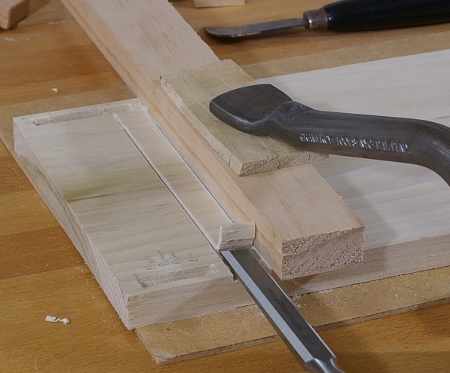
The next step was to remove the waste between the kerfs. I started with a chisel to get most of it out:

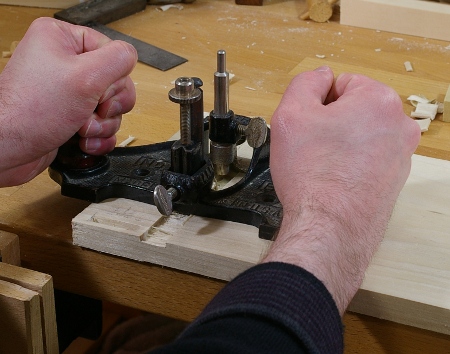
Then I went to the bottom with my router plane:

In this photo, I’ve stopped the board against a couple of bench dogs in the back. (I should have done this when I was chiseling, too.)

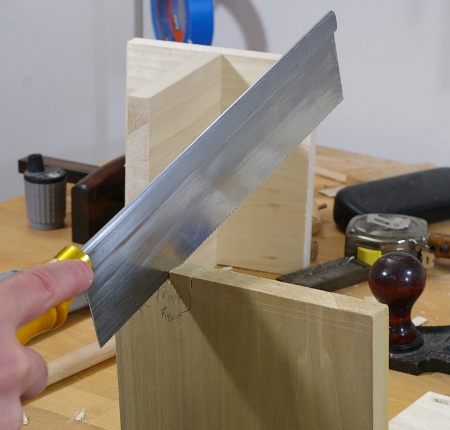
After the bottom was reasonably smooth, I turned my attention to the shelf section. I marked out the line where the board would protrude from the side first, then the line where the edge would meet the housing. Finally, I marked out a small tenon about an inch and a half into the board and sawed the cheeks:

And that’s all I had time for today. Notice my test joint making a cameo in the background behind the saw.

In the next installment, I’ll cut out the waste, chop the mortise, and clean up. Then I’ll have to do everything three more times.