Various handles and knobs

I’m in the process of varnishing four saw handles, a plane tote, and a plane knob. Here are half of the pieces.
As usual, I’m not being terribly speedy here. It’s been seven months since I started working on that tenon saw handle in the center. Things happen but I like to think that sooner or later, I get back to this stuff. (Especially since I’ve had the saw blade sharpened almost since I started on the handle and it’s otherwise ready to go.)

The larger hand saw handle in the rear is for a Disston D-8 that will become one of my new rip saws, somewhere at around 7TPI. This will be in addition to a No. 7 (I think) that’s going to be a larger 4.5TPI rip saw. The handle for that one is also in this batch, thankfully. Both of these handles were glopped over with some awful green paint that I needed to strip before the refinishing process started. What is it with the green paint?

The initial finish on these two handles was a mix of “colonial maple” stain, some satin polyurethane, and tung oil, for an oil/varnish blend (this makes the rays in the beech look nice). After a few coats of that, I’m now putting on satin polyurethane. I like the way that a top coat of polyurethane feels on the other handles I’ve done (as opposed to alkyd varnish and oil/varnish blends), and it seems to hold up better. It takes a little more effort to get polyurethane to look decent, but it’s not that bad.

I think I need one or two more coats on the handles.

The knob is from a Millers Falls #22 jointer plane that’s been waiting for restoration. I did not use the oil/varnish blend on this (or its accompanying tote), because the ray structure in this tropical wood did not seem worth bringing out. I may be done with the plane parts; I’ll evaluate that later.
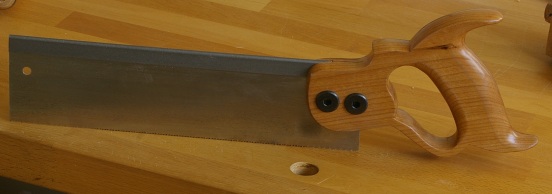
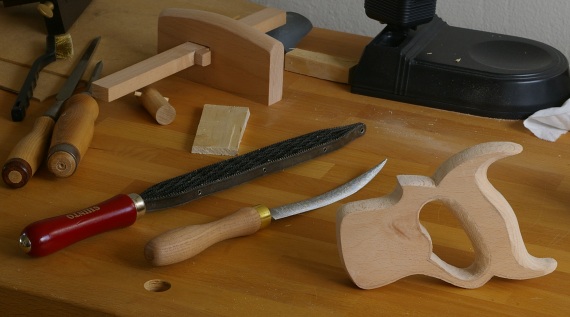
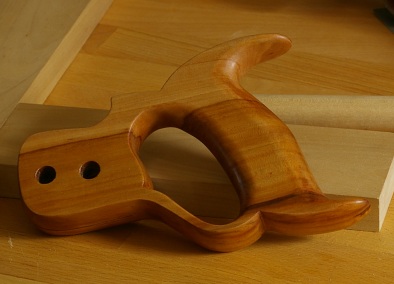
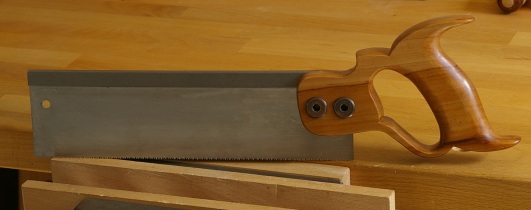
Carcase rip saw with cherry handle, finished

Well, it was a long time coming, but I finally finished this saw.

It has 13 teeth per inch, filed rip at a 0 degree rake angle. It cuts smoothly, but not super-quickly, as one would expect for a saw of this size and pitch. The finish on the handle turned out pretty well. I guess it had better, after, what was it, 10 coats of varnish?

And even though this one is done, there’s another one for a 16″ tenon saw in the works.

Those tools to the left are the Shinto saw rasp and the Gramercy sawmaker’s rasp.

Saw handle holes

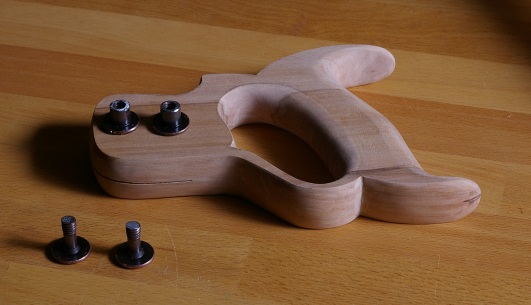
I somehow forgot exactly how I did the holes in my last saw handles, and I just had to do it again, so I’ll enumerate the steps so that I don’t have to remember the next time. Basically, you need to bore holes in the handle, with one side of the handle having larger holes than the other, because one side needs to house the saw nut, which is wider than the screw on the other side.

So here’s how (it assumes that you’ve already cut the sawblade kerf):

  1. Secure the handle with a sacrificial board underneath.
  2. Mark the holes on the screw side with an awl, using a template (or by hand).
  3. Drill all the way through with a brace and bit sized for the screw.
  4. Clean out the holes and sawblade kerf, flip over the handle, and resecure.
  5. Place a piece of paper in the sawblade kerf.
  6. Using a twist bit sized to the saw nut in the brace, enlarge the holes on the other side. Slowly ease your way in to prevent tearout and keep the hole centered.
  7. Stop when you hit the paper. After enlarging all of the holes, pull out the paper and clean out the sawblade kerf again.
  8. If necessary (this depends on your hardware), carefully use a countersink to countersink the holes on either side.

I suppose that it isn’t strictly necessary to have different-sized holes with the hardware that I’m using, but you definitely need to do it with older-style saw screws and nuts.

Cutting Gauge and Yet Another Handle

I haven’t been working on anything major lately, but two little projects that I haven’t mentioned before are coming close to completion:

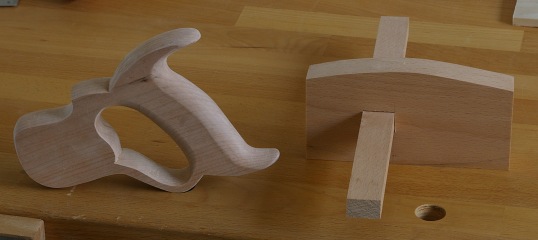
On the left, a handle made out of cherry. The template is identical to my apple handle, and the saw will be identical as well, except that it is filed rip instead of crosscut, so I will be using it for tenons and perhaps larger dovetails.

On the right, a cutting gauge made from scraps of beech. When complete, it will have a captive wedge to hold the arm tight, and some sort of wedged blade that I haven’t figured out yet. I’ll probably give it the same finish as my mallet.

Apple handle and small tenon saw: Finished

I spent about a million years applying varnish to the handle, and despite many distractions, I finished and rubbed it out today:

Since I was on a roll, I decided to finish the job today, too. First, I cut off the old handle, filed out the notch where the back fits into the handle, and drilled the holes:

Finally, I filed off the rough edges, put the blade into the saw, and inserted the mounting hardware.

I haven’t had time to really test it out yet, but it seems to feel okay in the hand.

Apple handle: Hardware cut

Though I did this a couple of weeks ago, I haven’t had a chance to post it until now. I managed to acquire a small bench vise for metalworking, and bolted it to a board, which I then, in turn, clamp to the bench when needed.

This was necessary to cut the saw screw/nut hardware for the new saw handle:

I used a mini hacksaw to cut these “furniture joiners” down to size, and then a file to smooth them. Then I used a brace to bore the holes in the handle (holes not shown here, but I think you know what holes in a handle look like).

The handle is now in the finishing stage. I’m using a clear satin varnish. It’s almost done; I screwed up the last thick coat, so I’ll need to sand that level and apply one more, but I should have the end product ready next week.

Apple handle: Shaping

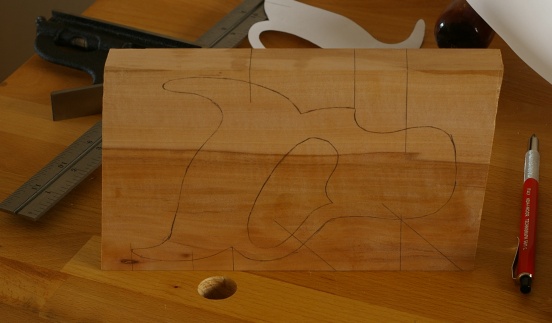
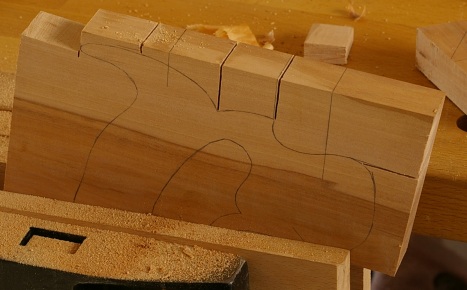
I suppose that I owe you some photos of the current stage of the apple handle. Here it is with the shape outlines, but before I started shaping:

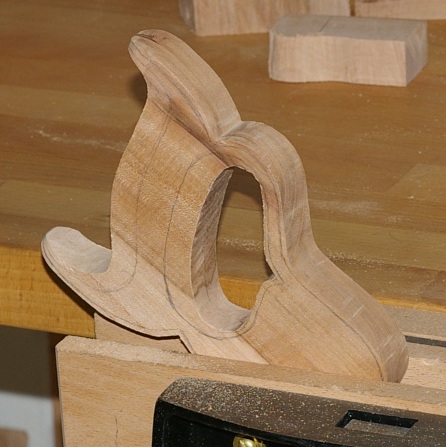
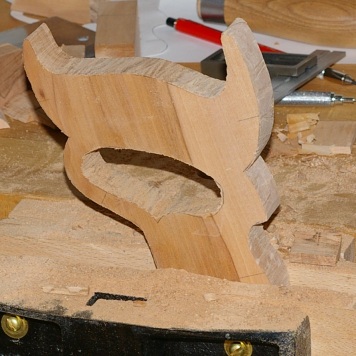
And here it is with the shaping mostly done, and the blade kerf cut:

That applewood, yum.

Apple handle: Start

I decided that since I had the momentum, and that since I had the drawing ready, that I would start a new saw handle, this time in apple. It will be for one of my small tenon/carcase saws, but I’m not sure which one yet.

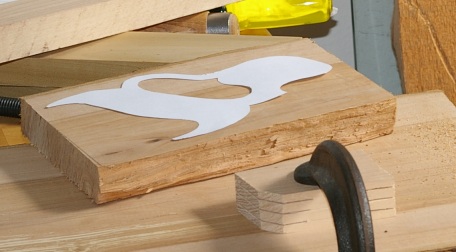
First, I cut a piece of the board and fit the pattern:

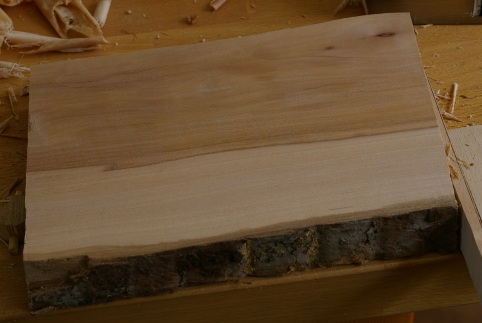
Then I milled the board. Here’s one face flattened:

The entire board is mostly clear, but the pith runs near the center. So when I cut the piece out, the pith is on one side. This is, in theory, not a problem.

At this stage, it was evident that apple is unlike any wood I’ve worked with in the past. The grain is kind of wavy, but it’s not a problem with sharp tools. The grain is also very fine, and when planed, it is very smooth.

It was also unusual because I did not mill the board four-square. Rather, I made the faces trapezoidal, just taking care to get the edges square to the faces, and that the thing was of course of uniform thickness. Once that was done, it was easy to transfer the pattern to the wood.

I still used a coping saw to cut out the pattern, but I used a few other saws to mark out sections. This made sawing easier.

It still wasn’t super-fast, but again, I don’t have power tools. But I did finish sawing today.

Scrub plane: finished

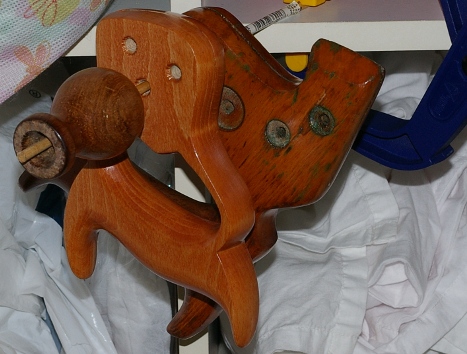
I decided to rub out the finish on the scrub plane last night, and call it “finished” for now.

I had remarked to my friend how much rubbing out a finish changes it. In this case, there are a lot of minor finishing screw-ups that somehow got less bogus in the process.

Looks aren’t everything, though, and in this tool’s case, maybe it isn’t even ugly enough for its intended task of hogging off wood. In any case, I have a new toy, and I want to try it out tonight.

Scrub plane: Starting the finish

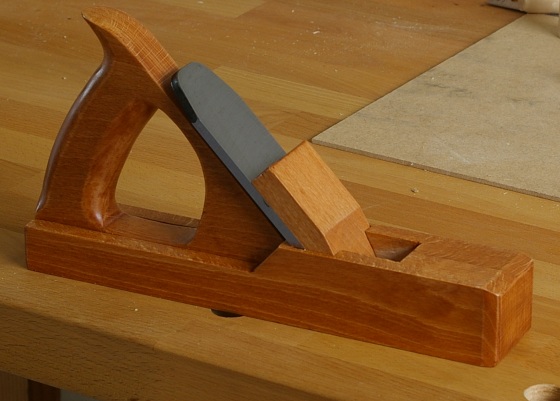
I did the final shaping and glue-up of the scrub plane’s tote a while back. That, along with the edge chamfering, left me with this:

I tested it, and found it much to my liking.

Because the tote will likely see heavy use, I decided to varnish it, and before doing that, I decided to stain it. I had a can of “golden pecan” (a pigment stain) in the cabinet, so I tried it out on a test piece of beech. It didn’t seem horrible, so here is the plane after two coats (with sanding between):

There is a little blotching. I believe that I should have probably done a washcoat. It seemed to have avoided a lot of problems on that old saw handle.

Though passable now, I feel that I should sand and do another coat of stain. The second coat evened things out a lot, so a third should do it most of the rest of the way?

After that step, I would like to even it out with clear varnish. Satin polyurethane again? It’s worked well for me so far.